Putting distance control comes from stroke length: double the backswing, four times the distance
- Putting
- Distance control
- Physics
- Fundamentals
Leaving a long putt well short, or hitting a short one too hard: most three-putts start with a mistake in distance, not in direction.
Controlling distance with the length of the stroke is a well-known practice method, but stroke length and distance are not proportional. Double the backswing and the ball rolls about four times as far. This article shows the relationship between backswing and distance in numbers, and how to adjust when the putt is uphill or downhill or the green speed changes. The numbers are calculated with the same physics model as the Putt Stroke Simulator. The explanation with formulas is collected in the appendix at the end.
The short answer
| Situation | What to think about |
|---|---|
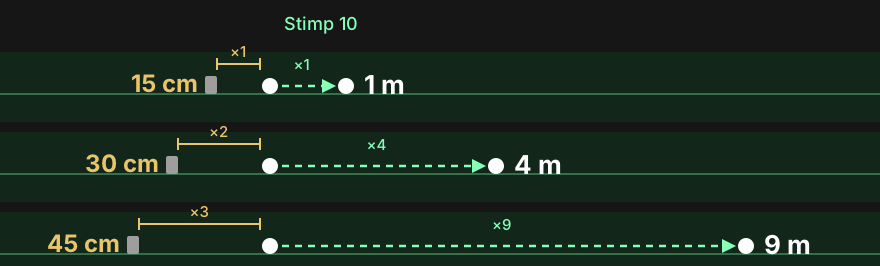
| Choosing the backswing | Distance grows with the square of the backswing. Play 1 m, 4 m and 9 m with backswings in the ratio 1 : 2 : 3 |
| Rhythm | Matters more than backswing. A rhythm just 5% quicker sends the ball 10% further. Use the same rhythm at every distance |
| Uphill and downhill | For each 1° of slope, add or subtract Stimp reading × 2.5% of the distance |
| Fast greens | The backswing you need changes less than you think. Going from Stimp 10 to 12 shortens it by a little under 10% |
| Missing the sweet spot | Strike 2 cm off centre and a blade loses about 8% of its distance, a large mallet about 4% |
The sections below go through the numbers behind this table.
Double the backswing, four times the distance
We changed the size of the takeaway (how far the head travels from the ball to the top of the backswing) and calculated how far the ball rolls. The rhythm is fixed (0.3 seconds from the top to impact), the green is flat at Stimp 10, and the putter is a typical blade.
| Backswing | Roll distance |
|---|---|
| 10 cm | 0.4 m |
| 15 cm | 1.0 m |
| 20 cm | 1.8 m |
| 25 cm | 2.8 m |
| 30 cm | 4.1 m |
| 40 cm | 7.3 m |
| 50 cm | 11.4 m |
A ball that rolls 1.8 m from a 20 cm backswing rolls 7.3 m from 40 cm. Twice the backswing gives about four times the distance. Between 10 cm and 50 cm, the distance differs by more than 25 times.
The reason is simple. With the same rhythm, head speed is proportional to backswing length, and roll distance is proportional to the square of the speed. When the speed doubles, the ball carries four times the kinetic energy, so it can travel four times as far against the resistance of the grass.
Put the other way round: if you hit a putt thinking "twice the backswing, twice the distance", it will go well past. Hitting a 10 m putt with twice the backswing of a 5 m putt rolls the ball about 20 m, not 10 m.
Backswing guide: 1 m, 4 m, 9 m
If distance goes with the square of the backswing, there is an easy combination to remember. The backswings for 1 m, 4 m and 9 m are exactly 1 : 2 : 3.
| Distance | Stimp 8 | Stimp 10 | Stimp 12 |
|---|---|---|---|
| 1 m | 17 cm | 15 cm | 14 cm |
| 2 m | 23 cm | 21 cm | 20 cm |
| 3 m | 28 cm | 26 cm | 24 cm |
| 4 m | 33 cm | 30 cm | 28 cm |
| 5 m | 36 cm | 33 cm | 31 cm |
| 6 m | 40 cm | 36 cm | 34 cm |
| 8 m | 46 cm | 42 cm | 39 cm |
| 9 m | 49 cm | 44 cm | 41 cm |
| 10 m | 51 cm | 47 cm | 43 cm |
| 12 m | 56 cm | 51 cm | 47 cm |
| 15 m | 63 cm | 57 cm | 53 cm |
At Stimp 10, 1 m is 15 cm, 4 m is 30 cm and 9 m is 44 cm: almost exactly 15, 30 and 45 cm. For the distances in between, backswing ≈ 15 cm × √distance (m) gives a good estimate.
The centimetre values themselves, though, vary from person to person with rhythm, putter and technique. The reliable way to find your own baseline is on the practice green:
- With your usual rhythm, hit a few balls with the same backswing and pace off how far they roll (this is your "base backswing")
- Double the backswing and check that the distance becomes 3.5 to 4 times as long
- Practise hitting distances in the ratio 1 : 4 : 9 with 1, 2 and 3 times your base backswing
The ratio (twice the backswing, four times the distance) holds whatever your rhythm or putter. The trick is to learn this ratio by feel, rather than the centimetre values.
Rhythm throws distance off more than backswing does
As much as backswing, and arguably more, distance depends on rhythm (the tempo of the stroke). Keeping the backswing for 4 m (about 30 cm at Stimp 10), we changed only the rhythm.
| Rhythm | 5% slower | Normal | 5% quicker |
|---|---|---|---|
| Roll distance | 3.6 m | 4.0 m | 4.4 m |
A rhythm just 5% quicker makes the ball roll about 10% further. For a stroke that takes 0.3 seconds from the top to impact, 5% is only 0.015 seconds. The reason putts run past under pressure is not the backswing but a quicker rhythm.
Bigger still is the habit of accelerating into the ball. With the same backswing and the same time, swinging with steady acceleration instead of like a pendulum makes the head about 1.3 times faster at impact, and a putt meant for 4 m rolls 6.5 m. This is why distance is inconsistent when you "hit at" the ball.
The order for making your distance control consistent is:
- First make the rhythm consistent (same tempo for long and short putts)
- Then vary the distance with backswing alone
If the rhythm is constant, distance is set by backswing alone. If the rhythm changes every time, the same backswing gives distances that vary by 10 to 20%.
Backswing errors matter more on short putts
We calculated how much the distance changes when the backswing is off by 2 cm (Stimp 10).
| Target distance | 1 m | 4 m | 9 m |
|---|---|---|---|
| Backswing needed | 15 cm | 30 cm | 44 cm |
| 2 cm shorter | 0.75 m | 3.5 m | 8.2 m |
| 2 cm longer | 1.3 m | 4.6 m | 9.8 m |
The same 2 cm is more than ±25% on a 1 m putt, but a little under ±10% at 9 m. The shorter the putt, the larger the share a small backswing difference takes. If your pace on putts of around 1 m is inconsistent, practising while checking your backswing by eye works well. In general, a backswing 10% off gives a distance about 20% off.
Uphill and downhill: "Stimp reading × 2.5%" per degree
Everyone knows to hit harder uphill and softer downhill, but by how much? We converted 3 m and 6 m putts on a slope into how many metres of pace they would need on a flat green.
| Slope | Stimp 8 | Stimp 10 | Stimp 12 |
|---|---|---|---|
| Downhill 2° | 60% | 50% | 40% |
| Downhill 1° | 80% | 75% | 70% |
| Flat | 100% | 100% | 100% |
| Uphill 1° | 120% | 125% | 130% |
| Uphill 2° | 140% | 150% | 160% |
At Stimp 10, 1° uphill adds 25% and 1° downhill takes away 25%. A 3 m putt 1° uphill needs the pace of a flat 3.75 m putt; 1° downhill, the pace of a flat 2.25 m. The percentage does not depend on the length of the putt: it is the same at 3 m and at 6 m.
The percentage works out to exactly Stimp reading × 2.5% (per degree of slope). The faster the green, the bigger the effect of slope: on a Stimp 12 green, 2° downhill, 40% of the flat pace is enough.
In backswing terms, a 3 m putt at Stimp 10 (26 cm on the flat) needs 29 cm 1° uphill and 22 cm 1° downhill. Backswing changes less than the distance percentage, so changing the backswing just a little is enough.
A 1° slope on a green rises about 1.7 cm for every metre. How to read slope is covered in "Three things to look at first when reading a green".
On fast greens the backswing barely changes
As the backswing guide table shows, going from Stimp 10 to 12 changes the backswing for 3 m only from 26 cm to 24 cm. A 20% change in green speed changes the backswing by less than 10%.
Backswing goes with the square root of distance, so a difference in green speed also shrinks to its square root. Even if fast greens make you feel "afraid to swing", the adjustment you actually need is small. What really changes on fast greens is the amount of break and the difference between uphill and downhill (see "What is a Stimpmeter? Green speed explained with physics").
Miss the sweet spot and distance goes first
Strike the ball away from the centre of the face and the head twists, passing less force to the ball. Keeping the backswings for 3 m and 6 m, we calculated the distance when the strike moves towards the toe (Stimp 10).
| Putter shape | Centre | 1 cm off | 2 cm off |
|---|---|---|---|
| Blade (3 m / 6 m) | 3.0 m / 6.0 m | 2.9 m / 5.9 m | 2.8 m / 5.5 m |
| Large mallet (3 m / 6 m) | 3.0 m / 6.1 m | 3.0 m / 6.0 m | 2.9 m / 5.9 m |
With a blade, missing the centre by 2 cm leaves a 6 m putt about 50 cm short. With a large mallet the difference is about 25 cm, roughly half that of the blade. A putter with a high moment of inertia is forgiving not just in direction but in distance too.
If your long putts are inconsistent in distance, check that you are hitting the centre every time before you look at your backswing. Draw a line on the ball with a marker and hit it: the mark shows where on the face you made contact.
Summary
- Double the backswing and the distance becomes about four times. Distance grows with the square of the backswing
- At Stimp 10, 1 m, 4 m and 9 m take almost exactly 15, 30 and 45 cm (1 : 2 : 3)
- What throws distance off most is rhythm. Just 5% quicker and the ball goes 10% long. Make the rhythm consistent first
- For uphill and downhill, add or subtract Stimp reading × 2.5% of the distance for each 1° of slope
- When greens get faster, the backswing adjustment is smaller than you think
- Missing the sweet spot costs distance, more so with a blade
To see how backswing and distance change with your own rhythm and putter, move the backswing, period and strike point in the Putt Stroke Simulator. For how far past the hole to aim your pace, see "Is "17 inches past" really the best pace?".
Appendix: the calculations
From here on, the numbers in the article are explained with formulas.
Backswing and head speed
Treat the stroke as a pendulum (simple harmonic motion) with backswing A and period T (one full swing back and forth). The head position is x(t) = A cos(2πt / T), and its speed at the bottom (impact) is
v_head = 2π A / T
From the top to impact takes T/4; the article uses T = 1.2 s (0.3 s). Swinging through the same distance A in the same time T/4 with constant acceleration gives v_head = 8A / T, which is 4/π ≈ 1.27 times the pendulum. That is the "1.3 times when accelerating" in the article.
Head speed and ball speed
When a head of mass M hits a stationary ball of mass m, with coefficient of restitution e,
v_ball = (1 + e) M / (M + m) × v_head
With M = 345 g, m = 45.9 g and e = 0.85, v_ball ≈ 1.63 v_head. The calculations in the article solve the collision in three dimensions with the head and ball as rigid bodies, and the twisting of the head on an off-centre strike comes out of this as well.
Ball speed and roll distance
If the deceleration from the grass is μg (μ is the rolling resistance coefficient), a ball that starts rolling at speed v stops after
D = v² / (2 μ g)
Putting all this together,
D ∝ v_ball² ∝ (A / T)² ⇒ A ∝ T √D
so distance is proportional to the square of the backswing and inversely proportional to the square of the period. For small changes,
ΔD / D ≈ 2 ΔA / A − 2 ΔT / T
A backswing 10% off gives a distance 20% off, and a period 5% shorter makes the distance 10% longer.
In the full calculation, the ball leaves the face slightly airborne and skids for a while, losing some speed (see "The first 20% of a putt is not rolling at all"). The resistance of the grass also rises a little just before the ball stops, so short distances depart slightly from the square law. This is why the backswings for 1 m, 4 m and 9 m come out at 15, 30 and 44 cm, slightly less than exactly 1 : 2 : 3.
Converting for slope
Going up a slope of angle φ, the slope pushes the ball back, so deceleration increases. For a rolling ball, 5/7 of that acts to slow it along its path (the rest goes into slowing its spin).
deceleration = μ g ± (5/7) g sin φ (+ uphill, − downhill)
Converting the pace needed to roll the same distance into a flat-green distance gives
flat-equivalent ratio = 1 ± (5/7) sin φ / μ
The Stimp reading S [ft] is how far a ball sent off at a fixed speed v_s ≈ 1.72 m/s rolls, so μ = v_s² / (2 g S), and
(5/7) sin φ / μ = (5/7) sin φ × 2 g S / v_s² ≈ 0.025 × S × (φ [°])
That is 2.5% of the Stimp reading per degree of slope. The distance D does not appear in the formula, so the percentage does not depend on the length of the putt.
Conditions: this site's physics model (head speed from a pendulum stroke, the head–ball collision solved in three dimensions, then hop, skid and pure rolling until the ball stops). Putter: blade (345 g head, moment of inertia 4,000 g·cm², coefficient of restitution 0.85, loft 3°), period 1.2 s, Stimp 10, flat, no grain. The large mallet in the off-centre comparison is 365 g and 8,500 g·cm². "Off centre" keeps the backswing that gives 3 m and 6 m on a centre strike and moves only the strike point towards the toe.