Blog
Notes on the physics of golf and the decisions it informs.
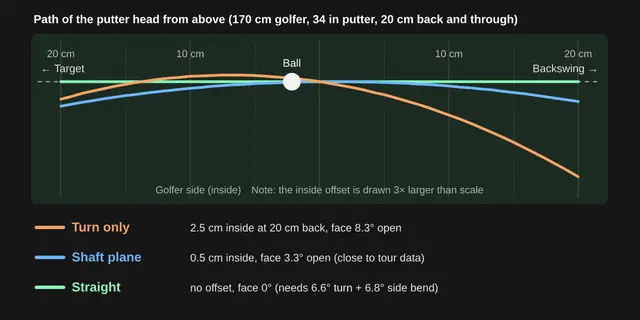
Can you really take the putter straight back? The stroke path your skeleton allows, checked against tour data
You may be trying to go straight back and straight through, but when you lean over the ball and turn your shoulders, the putter head moves on an arc to the inside. A skeleton model shows a shoulder turn alone goes 2.5 cm inside at 20 cm back, and a straight path needs about as much side bend as turn. This article compares that with measurements of 99 PGA Tour players, shows how build and grip change it, and what to do with it in practice.
- Distance & pace
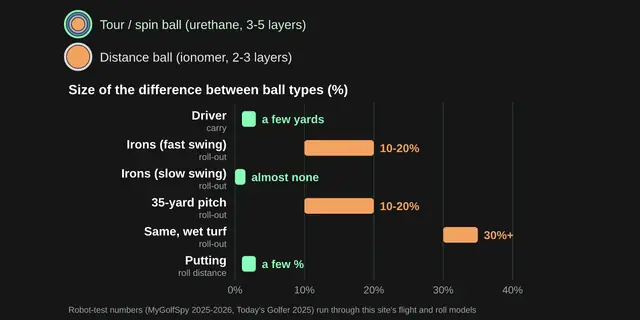
How much does the golf ball really matter? Tour (spin) balls vs distance balls, tested with physics and robot data
How much do your shots and putts change between a tour ball (urethane cover) and a distance ball (ionomer cover)? Instead of marketing claims, we used robot-test numbers from 2025-2026 and this site's flight and roll models. The difference is large on short pitches and from wet turf, and small for slower swingers' drivers and irons, and on putts.
- Full-swing yardage
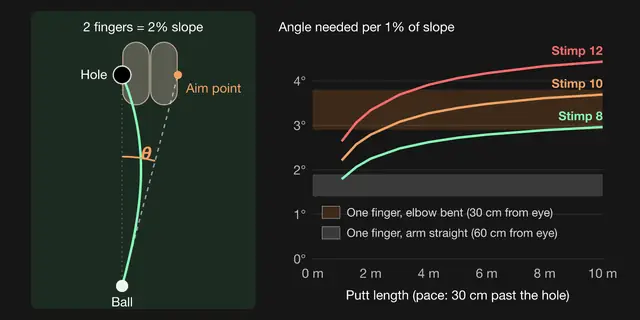
Is AimPoint physically correct? Testing the finger method with a ball-roll model
AimPoint has you feel the slope with your feet and pick an aim point with your fingers. We summarise how the method is taught on various sites, then use a ball-roll model to check whether the finger angle is physically right. The answer: the idea is sound, but the angle one finger should cover changes a lot with green speed, and one finger at arm's length is not enough. We also cover how to get more precise, how to correct for differences in finger width and arm length, and the main criticisms of AimPoint, from a neutral point of view.
- Greens & ball roll
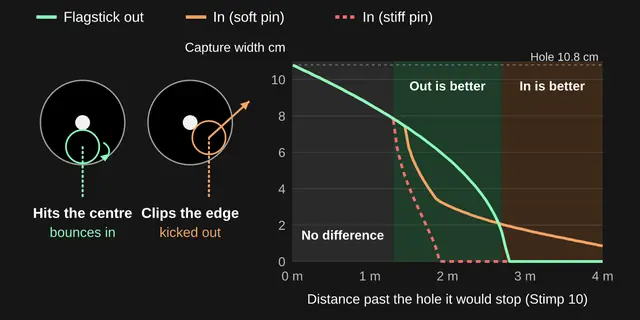
Flagstick in or out when putting? A physics model gives the answer
Since the 2019 rule change you can putt with the flagstick left in. Some say it helps you hole more putts, others say it costs you. We worked it out from the condition for a ball to drop into the hole and from how the ball rebounds off the pin. The answer: at normal pace it makes almost no difference, so take it out if in doubt. Leaving it in only pays when a putt that is far too fast hits the pin dead centre. The common advice to take it out on uphill putts also turns out to be physically correct.
- Distance & pace
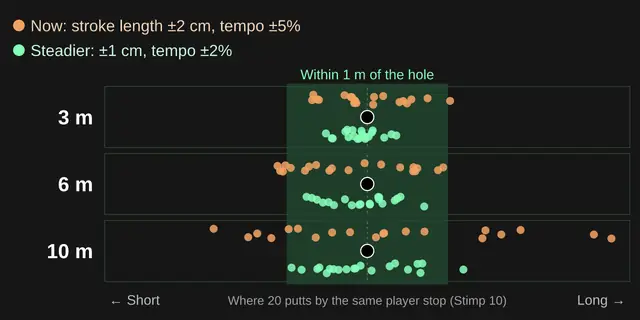
How to make your putting distance more consistent: measure your spread as a percentage, then remove the causes one by one
You hit the same putt and the ball stops somewhere different every time. Splitting the causes apart with a physics model shows that on short putts most of the spread comes from stroke length, and on long putts from tempo. Drawing on coaches and data published at home and abroad since 2024, this article shows how to measure your own spread and the order in which to practise to reduce it. It also estimates, by level of player, how many strokes this saves over 18 holes.
- Distance & pace
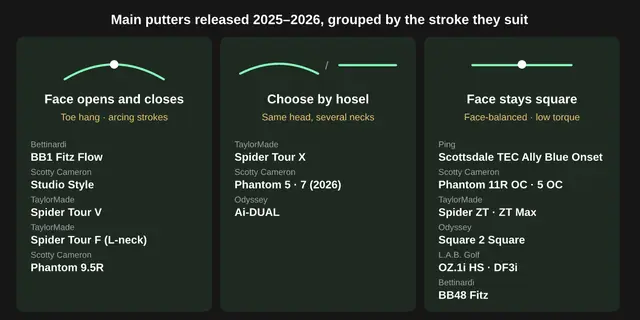
New putters of 2025–2026 compared: what the top tour players use, and how to find the one that fits you
The main new putters released in 2025 and 2026, compared by head shape, hosel and the stroke they suit. Where we could confirm it, we list the top-ranked men's and women's tour players who use each one. At the end, a step-by-step way to narrow it down to the putter that fits you.
- Putters & gear
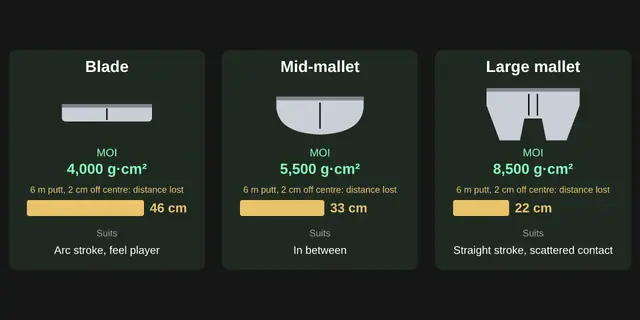
Choosing the right putter: blade vs mallet, by stroke, build and personality
Who does a blade, a mid-mallet or a large mallet actually help, and how? Calculating the spread in contact point, face angle and tempo with a physics model separates cleanly what the putter type changes from what it does not. This article works through three angles, stroke shape, build and personality (habits), to find the putter that suits you.
- Putters & gear
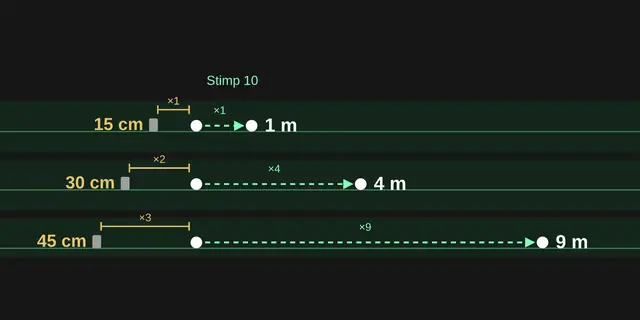
Putting distance control comes from stroke length: double the backswing, four times the distance
Stroke length and roll distance are not proportional. Double the backswing and the ball rolls about four times as far. Using a physics model, this article sets out the backswing for 1 m, 4 m and 9 m, how to adjust for uphill, downhill and green speed, and why a change in rhythm throws distance off more than backswing does. The full calculations are in the appendix at the end.
- Distance & pace
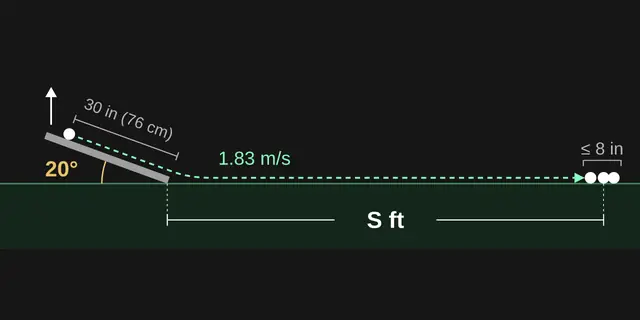
How to measure green speed with a Stimpmeter, and what the number means
How to measure green speed with a Stimpmeter, and what "the greens are running at 10" really means. From the measuring steps to what to watch for on fast and slow greens, explained with clear numbers. The full calculations are in the appendix at the end.
- Greens & ball roll
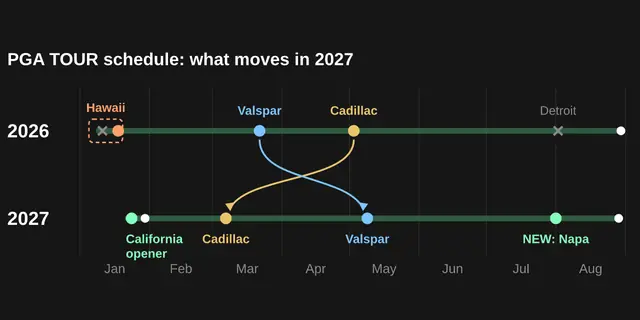
What changes on the 2027 PGA TOUR schedule? The differences from 2026, explained
The Hawaii swing is gone and the season opens in California. The Cadillac Championship moves from May to March and the Valspar Championship from March to May. We compare the 2027 PGA TOUR schedule with 2026 and explain what changes and what is still undecided, with sources.
- Pro tours
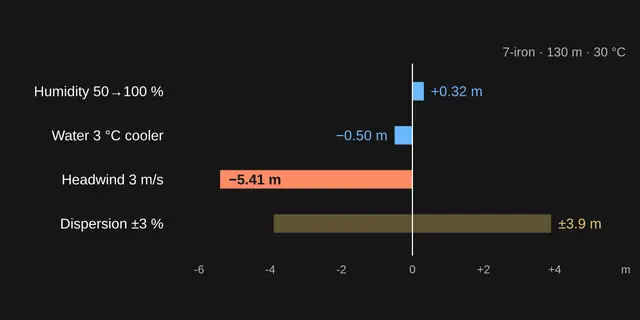
Water vapour is not what costs you distance
The ball falls in the water, the story goes, because vapour over the pond makes the air heavy and the shot comes up short. Run it through the ball-flight model and humid air turns out to be lighter, and the ball carries further — by about a foot with a 7-iron.
- Full-swing yardage
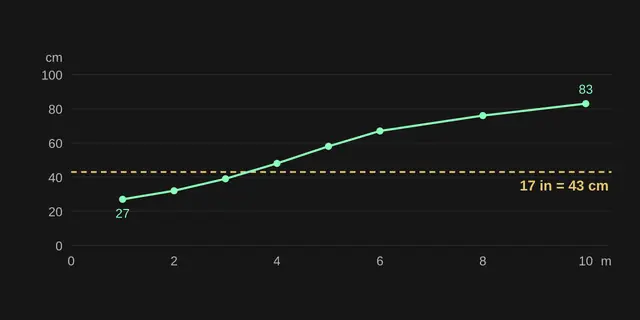
Is "17 inches past" really the best pace?
The most famous rule in putting says to hit it hard enough to finish 43 cm past the hole. Tested against the simulator it holds up remarkably well on flat and uphill putts — downhill is a different story.
- Distance & pace
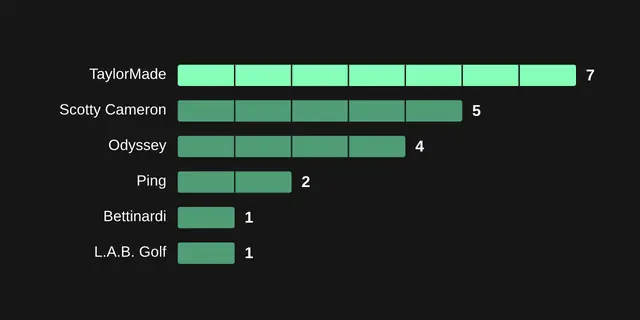
Who is the number 1 putter on the PGA Tour? The putters of the world top 20, ranked
Which putters the top 20 in the world ranking actually use, down to the model, with a usage ranking and each player's putting statistics. Plus how the two players behind the headline numbers actually stroke it.
- Putters & gear
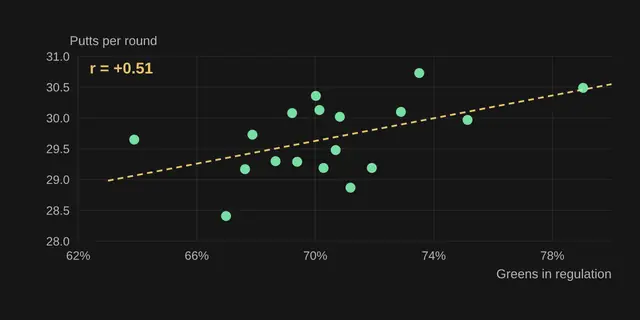
Fewer putts does not mean a better putter
Line up greens in regulation against putts per round for the top 20 women in the world and you get a clean positive correlation — the more greens you hit, the more putts you take. Here is what that says about reading putting statistics.
- Pro tours
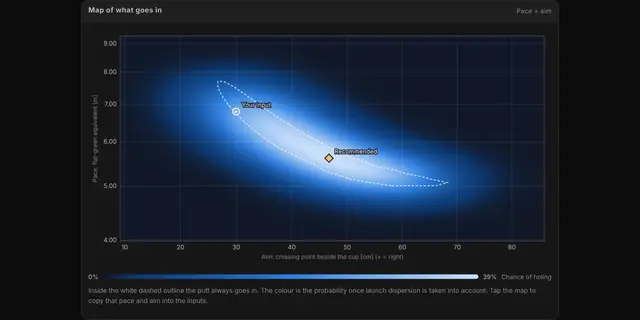
Is it better to "hit it firm" or to "play the line"?
There is a trade-off between how much pace and how much direction you are allowed to miss by. Starting from the formula for the speed at which a cup can capture a ball, we compute the aim window and the break for each pace and find which touch holes the most putts.
- Distance & pace
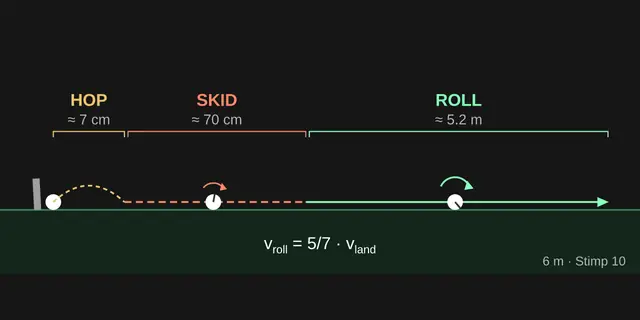
The first 20% of a putt is not rolling at all
Straight after impact the ball is airborne, then sliding. How long that phase lasts and what changes it — green speed, loft, topspin — compared in numbers, plus the real reason a putt barely breaks early on and what it means on the course.
- Greens & ball roll
Temperature, altitude and wind: how many clubs?
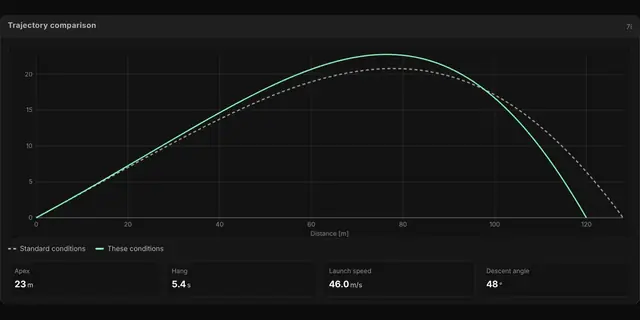
Enter your baseline carries once, and the tool tells you which club today's conditions really turn each one into. How to use the Carry Range Finder, how temperature, altitude, wind and elevation act, worked examples from a summer mountain course to a winter seaside links, and rules of thumb for the course.
- Full-swing yardage
Three things to look at first when reading a green
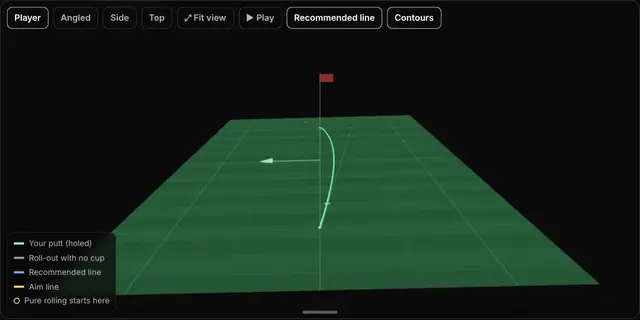
Checking the direction of slope, green speed and the slope along the whole line — in that order — sharpens your line more than anything else. Using equations and simulation numbers, we show how break changes with slope, distance, Stimp reading and pace, how far a misread sends the ball, and turn it into a routine for the green.
- Greens & ball roll