Flagstick in or out when putting? A physics model gives the answer
- Distance & pace
Since the 2019 rule change, there is no penalty for putting on the green with the flagstick left in the hole. Ever since, you hear both "leave the pin in, more putts drop" and "no, take it out, more putts drop".
Even the experts disagree. Dave Pelz, well known for his putting research, says leaving it in holes more putts. A Golf Digest test by Professor Tom Mase of California Polytechnic State University found that "in most cases you are better off taking it out".
In this article we work the question out again from two pieces of physics: the condition for a ball to drop into the hole and how the ball rebounds when it hits the pin. The formulas are collected in the notes at the end. The main text gives only the conclusions and the reasons.
The short answer
| Situation | What to do |
|---|---|
| Normal pace (would finish about 40 cm past) | Either is fine. The difference is less than one putt in 100 |
| Firm pace (about 1 m past) | Taking it out holes slightly more |
| Charging it, nearly 2 m past | Taking it out clearly holes more |
| Uphill putts | Take it out. Even for a putt that finishes the same distance past, the ball reaches the hole still moving fast uphill, so the pin kicks it out more easily |
| Downhill putts | Either is fine. The ball arrives slowly, so the pin hardly matters. Leave it in and save time |
| So fast it would roll 3 m or more past on a flat green | With a soft pin, leave it in. It only helps if the ball hits the pin dead centre |
| Metal or other stiff pins, or a pin leaning towards you | Take it out |
| When in doubt | Take it out. The difference is small, so leaving it in on long putts to save time costs almost nothing |
| Rules | Decide before the stroke. A ball resting against the pin is holed if any part of it is below the surface |
Over a round, the difference for an average amateur is at most about 0.1 strokes. Hitting your putts to finish about 40 cm past the hole matters far more than what you do with the pin.
The rules in brief
Under the current Rules (Rule 13.2), on the putting green you can choose one of three options:
- Putt with the flagstick left in (no penalty if the ball hits it)
- Have the flagstick removed before the stroke
- Have someone attend it and remove it after the stroke
You must decide before the stroke. If your ball comes to rest against the flagstick, it is holed if any part of the ball is below the surface of the green. If no part of it is below the surface, it is not holed. If the ball moves when the flagstick is removed, it is placed on the lip of the hole and played from there.
The experts disagree
The best-known voice for leaving it in is Dave Pelz. He rolled balls with a machine and concluded that a ball that hits the pin loses speed and is more likely to drop, so "you will hole a higher percentage of putts when you leave the flagstick in" (GOLF.com). A machine test by MyGolfSpy also found that leaving it in was always an advantage (MyGolfSpy).
The Golf Digest test (updated August 2024) found almost the opposite (Golf Digest).
- Balls that hit the centre of the pin all went in, with or without the pin, up to a pace that would carry 2.4 m (8 feet) past
- At a pace that would carry 2.7 to 3 m (9 to 10 feet) past, more than half missed with the pin out. With a fibreglass pin in, almost all dropped even at 4 m (13 feet) past
- Balls that clipped the edge of the pin, at a pace that would carry 1.4 m (4.5 feet) past, dropped 90% of the time with the pin out, but only 61% with a fibreglass pin and 36 to 38% with aluminium pins
An analysis by Chris Bilder, a statistician at the University of Nebraska, found the same pattern: "no meaningful difference for slow putts, better odds with the flagstick out at medium speed, and better odds with it in at high speed, but mostly when the ball hits it dead centre" (University of Nebraska).
The results seem to conflict because the answer depends on how fast the ball is moving and where it hits the pin. Physics lets us sort this out.
The condition for holing: 0.066 seconds
When the ball reaches the hole, it starts to fall. If it has dropped by its own radius (2.1 cm) by the time it reaches the far edge, it hits the wall of the hole and stays in. If it reaches the far edge before it has dropped that far, it climbs over the lip and rolls out.
Falling 2.1 cm takes just 0.066 seconds. The hole is 10.8 cm wide, so a ball rolling over the centre drops as long as it does not cover 10.8 cm in 0.066 seconds, that is, up to 1.63 m/s. On a Stimp 10 green, that is the pace of a putt that would finish about 2.7 m past the hole. This agrees well with the Golf Digest finding that, with the pin out, putts stopped dropping at a pace of 2.7 to 3 m past.
A ball that crosses near the edge of the hole spends less distance over it, so it has to be slower to drop. The harder you hit it, the "narrower" the hole becomes.
What happens when the ball hits the pin
The Rules limit the flagstick to a diameter of 1.9 cm (3/4 inch) at its base (Golf Digest, January 2026). Add the ball's 2.1 cm radius to the pin's 1 cm radius, and any ball whose centre passes within 3.1 cm either side of the centre of the hole hits the pin. The hole is 10.8 cm wide, so more than half of all balls that cross the hole hit the pin.
There are two ways to hit it:
- Dead centre: the ball bounces straight back. The pin soaks up its speed, so it rebounds slowly and spends longer over the hole. That is why even a ball that is too fast can drop. This is the effect Pelz describes
- A glancing blow: the ball is kicked sideways. It keeps most of its speed and heads for the nearer edge, so it spends less time over the hole. A ball that would have dropped without the pin rolls out instead
Which effect wins depends on the speed of the ball. A slow ball drops before it reaches the edge even if the pin deflects it, so it goes in either way. At medium speed, the loss from glancing blows stands out. A very fast ball would roll out even over the centre with the pin out, so only the gain from dead-centre hits remains.
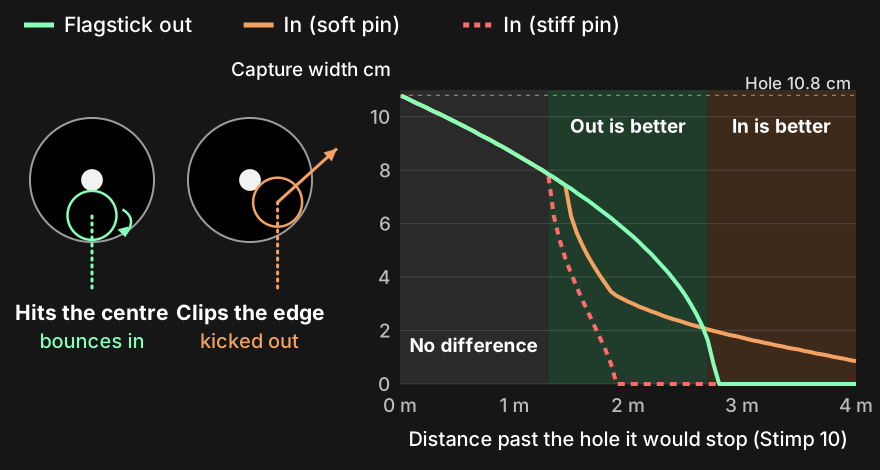
Comparing the "capture width"
We calculated the width of the hole within which a crossing ball still drops (Stimp 10, flat green). All values are in cm. The hole is 10.8 cm wide.
| Distance past the hole it would stop | Out | In (soft pin) | In (stiff pin) |
|---|---|---|---|
| 0.5 m | 9.8 | 9.8 | 9.8 |
| 1.0 m | 8.6 | 8.6 | 8.6 |
| 1.5 m | 7.3 | 6.3 | 4.1 |
| 2.0 m | 5.7 | 3.1 | 0 |
| 2.5 m | 3.3 | 2.3 | 0 |
| 3.0 m | 0 | 1.7 | 0 |
| 4.0 m | 0 | 0.9 | 0 |
The "soft pin" stands for the common fibreglass flagstick. We set how strongly it rebounds so that the model matches the Golf Digest test. The "stiff pin" stands for aluminium or other pins that rebound more.
The table shows three things:
- Up to a pace of about 1.3 m past, there is no difference at all. Ordinary lag putts fall in this range
- Firmer than that, up to 2.7 m past, taking the pin out leaves a wider capture width. The gap opens at 1.3 m past with a stiff pin and at 1.5 m past with a soft one. With a stiff pin, nothing drops at 2 m past
- Only beyond 2.7 m past does leaving it in help. Even then the capture width is 2 cm or less, so the ball has to hit almost dead centre
How many putts does it actually change?
Real putts vary in both pace and line. For an average amateur, we let the finishing point vary by ±15% of the putt length from the target, and the line by ±5% of the length to either side, and simulated 100,000 putts for each case (Stimp 10). The figures are the percentage holed.
Aiming to finish 40 cm past (normal pace)
| Putt length | Out | In (soft) | In (stiff) |
|---|---|---|---|
| 2 m | 34.2% | 34.2% | 34.2% |
| 5 m | 10.1% | 9.9% | 9.5% |
| 10 m | 3.5% | 3.3% | 2.8% |
Aiming to finish 1 m past (firm)
| Putt length | Out | In (soft) | In (stiff) |
|---|---|---|---|
| 2 m | 33.2% | 32.8% | 31.7% |
| 5 m | 11.6% | 10.8% | 9.6% |
| 10 m | 3.8% | 3.6% | 2.9% |
Hitting it 2 m past (too hard)
| Putt length | Out | In (soft) | In (stiff) |
|---|---|---|---|
| 2 m | 21.8% | 13.7% | 3.4% |
| 5 m | 8.1% | 6.8% | 3.8% |
| 10 m | 3.3% | 3.1% | 2.1% |
At normal pace, the difference is 0.2 to 0.7 putts per 100. The gap grows when you hit a short putt too hard, and then taking the pin out holes far more.
Leaving it in only came out ahead when a 2 m putt was struck hard enough to finish 3 m past (out 2.2%, soft pin 7.1%). Nobody normally hits a putt that hard.
We also checked whether the pin, by stopping the ball, leaves shorter comebacks on misses (the "avoid three-putts" effect). So few balls hit the pin dead centre and still miss that the share of misses leaving more than 1 m barely changed.
Is "out uphill, in downhill" right?
You sometimes hear that you should take the pin out for uphill putts and leave it in for downhill ones. Plenty of golfers have had an uphill putt bounce straight back off the pin. The physics backs this up: taking it out uphill is correct. For downhill putts, "leaving it in costs you nothing" is the more accurate way to put it.
Uphill, the ball is still moving fast as it crosses the hole
On an uphill putt the slope acts as a brake, so the ball slows down and stops quickly. That means a ball that will finish 1 m past the hole still has plenty of speed as it crosses the hole. Think of riding a bike uphill: stop pedalling and you stop almost at once, so to roll "one more metre and then stop" you need a fair bit of speed at that point.
Downhill it is the other way round. The slope keeps pushing the ball, so even a ball that finishes 1 m past crosses the hole slowly.
Here is how fast a ball that will finish 1 m past the hole is moving as it crosses the hole (Stimp 10).
| Slope | Speed over the hole |
|---|---|
| 3% downhill | 0.62 m/s |
| Flat | 0.99 m/s |
| 3% uphill | 1.25 m/s |
A fast ball that clips the edge of the pin is kicked sideways with its speed intact and gets over the lip before it can drop (as explained in "What happens when the ball hits the pin"). So for putts that finish the same distance past, an uphill putt still hits the pin fast and is more easily kicked out. That is why uphill putts sometimes bounce off the pin.
On a Stimp 10 green, a 3% uphill slope slows the ball like a slow Stimp 6 green, and a 3% downhill slope like an extremely fast Stimp 25 green. The condition for dropping (falling 2.1 cm in 0.066 seconds) hardly changes on a slope. Only the speed at which the ball arrives changes.
As a result, the points where the pin starts to matter shift a long way (Stimp 10).
| Slope | Pin out holes more from | Pin in (soft) holes more from |
|---|---|---|
| 3% downhill | 3.7 m past or more | 6.8 m past or more |
| 1% downhill | 1.8 m or more | 3.3 m or more |
| Flat | 1.5 m or more | 2.7 m or more |
| 1% uphill | 1.2 m or more | 2.2 m or more |
| 3% uphill | 0.9 m or more | 1.7 m or more |
On a 3% uphill putt, glancing blows off the pin already start to cost you at a pace of 1 m past, which is just a normal firm putt. And since golfers tend to hit uphill putts firmly so as not to leave them short, they are even more exposed.
Comparing real putts
We used the same scatter as on the flat (±15% in distance, ±5% sideways) and simulated 100,000 putts each. The figures are the percentage holed.
A 2 m putt hit to finish 1 m past
| Slope | Out | In (soft) | In (stiff) |
|---|---|---|---|
| 3% uphill | 26.5% | 21.6% | 14.7% |
| Flat | 33.2% | 32.8% | 31.7% |
| 3% downhill | 38.2% | 38.2% | 38.2% |
A 3 m putt hit to finish 40 cm past
| Slope | Out | In (soft) | In (stiff) |
|---|---|---|---|
| 3% uphill | 18.6% | 18.0% | 16.9% |
| Flat | 20.4% | 20.4% | 20.3% |
| 3% downhill | 21.9% | 21.9% | 21.9% |
Hit an uphill putt firmly with the pin in and you hole 5 fewer putts in 100 (12 fewer with a stiff pin). Having an uphill putt kicked out by the pin is not bad luck. Physics makes it likely.
On a 3% downhill putt, on the other hand, the holing rate was exactly the same with the pin in or out. The ball arrives so slowly that hitting the pin does not change whether it drops. Leaving it in only pays on a 3% downhiller struck hard enough to run nearly 7 m past, which does not normally happen.
In short:
- Out uphill: correct. The difference is clear when you hit an uphill putt of 1 to 3 m firmly
- In downhill: costs you nothing, but gains almost nothing either, so it really means "no need to take it out". Skipping the walk to the pin speeds up play
Fast and slow greens
Green speed shifts the points for the same reason. A slow green works like an uphill putt: a ball that finishes the same distance past still crosses the hole fast, so the pin kicks it out more easily.
| Green speed | Pin out holes more from | Pin in (soft) holes more from |
|---|---|---|
| Stimp 8 | 1.2 m past or more | 2.1 m past or more |
| Stimp 10 | 1.5 m or more | 2.7 m or more |
| Stimp 12 | 1.8 m or more | 3.2 m or more |
With a stiff pin, the point where taking it out starts to help comes about 10% earlier (1.3 m on a flat Stimp 10 green).
Chipping from off the green
Pelz has said that leaving the pin in holed 35% more chips from off the green (Today's Golfer). Chips vary more in pace, and many run well past, so the pin's ability to stop a dead-centre hit has more chances to help.
When we ran our model for a bump-and-run (pace varying ±25% of the distance, line ±8%), the difference in holing rate between pin in and pin out was less than one chip in 100. From off the green, the difference is small enough that pace of play can decide it. Since nobody has to walk over and remove it, most golfers will leave it in when chipping.
Does it help as a visual target?
Some golfers say the pin makes the hole easier to see and helps their distance control. In the Golf Digest test, 36 college golfers hit 7.6 m (25-foot) putts. The average finish was 60 cm from the hole with the pin out and 65 cm with it in, so there was no clear difference. How things look is a personal matter, so use whichever you feel more comfortable over.
What to do on the course
- Makeable putts of 1 to 3 m: take it out. You want to hit these firmly, so a glancing blow off the pin costs you
- Lag putts of 5 m or more: almost no difference. Leave it in if you don't want to keep your partners waiting
- Uphill putts: take it out. Especially when you hit an uphill putt of 1 to 3 m firmly, a glancing blow off the pin costs a lot
- Downhill putts: leaving it in is fine. The holing rate barely changes, so you can skip removing it
- Metal or thick pins: take it out. They rebound harder and kick glancing balls out
- A pin leaning towards you: the gap between pin and lip on your side gets narrower and the ball hits the pin sooner. Take it out, or have it set straight in the centre of the hole
- Windy days: the pin moves and the gaps change. Take it out
Summary
- A ball over the hole drops if it falls 2.1 cm within 0.066 seconds. A ball over the centre drops at up to 1.63 m/s (a pace of about 2.7 m past on Stimp 10)
- The base of the flagstick is at most 1.9 cm thick, and more than half of all balls that cross the hole hit it
- A ball that hits the centre of the pin loses speed and drops more easily. A ball that clips the edge is kicked sideways and rolls out more easily
- At normal pace, up to about 1.3 m past, the pin makes no difference
- Firmer putts, 1.3 to 2.7 m past, drop more with the pin out (from 1.5 m with a soft pin). The gap is larger with stiff pins
- Out uphill is physically correct: even for a putt that finishes the same distance past, the ball reaches the hole still moving fast uphill, so the pin kicks it out more easily. In downhill costs nothing, but gains almost nothing either
- Leaving it in only helps when a putt that would run more than 2.7 m past hits a soft pin dead centre
- The difference over a round is at most about 0.1 strokes. When in doubt, take it out. Hitting your putts to finish about 40 cm past matters far more
For how far past to aim, see "Is "17 inches past" really the best pace?". For how to make your pace more consistent, see "How to make your putting distance more consistent".
Notes: the calculations in detail
The condition for holing
We assume the ball starts to fall freely as soon as its centre passes the edge of the hole, and that it drops if it has fallen by its radius r before it reaches the far edge (the approach of Holmes (1991), also used by this site's simulator).
Time to fall          T = √(2r / g) = √(2 × 0.02134 / 9.807) ≈ 0.066 s
Maximum capture speed v_max = c / T
c is the length of the chord over the hole. For a line b to either side of the centre, c = 2√(R² − b²)
(R = 0.054 m is the radius of the hole)
Over the centre (b = 0), v_max ≈ 1.63 m/s.
Speed and "distance past the hole"
The deceleration a of a rolling ball on a flat green follows from the Stimp reading S. Taking the speed at which the ball leaves the Stimpmeter as v₀ ≈ 1.72 m/s,
a = v₀² / (2S)              (Stimp 10 = 3.05 m gives a ≈ 0.485 m/s²)
Speed at the hole of a ball that would stop D past it:  v = √(2aD)
v = 1.63 m/s corresponds to D ≈ 2.7 m on Stimp 10.
The collision with the pin
We take the radius of the base of the pin as p = 9.5 mm (3/4 inch diameter) and make the ball collide when the distance between the centre of the ball and the centre of the pin reaches r + p (30.8 mm). The velocity component normal to the contact is reversed and multiplied by the coefficient of restitution e. The tangential component is kept. After the collision the ball travels in a straight line to the edge. If the total time from entering the hole to reaching the edge is at least T, the ball drops.
A ball that hits the centre of the pin drops if
time over the hole = (R − r − p)/v + (R − r − p)/(e v) ≥ T
In the Golf Digest test, balls that hit a fibreglass pin dead centre almost all dropped even at a pace of 4 m (13 feet) past, so we set e = 0.2 (soft pin) to match. The limit for a dead-centre hit is then a pace of 4.6 m past on Stimp 10. For a stiff pin we used e = 0.35 (dead-centre limit 1.9 m past).
The model also reproduces the trend in the Golf Digest results that glancing hits stop dropping from a pace of about 1.4 to 1.5 m past, and that stiffer pins hole fewer.
On a slope
On a slope s (positive uphill), the rolling deceleration becomes a = a₀ + g·s, where a₀ is the deceleration on the flat. On Stimp 10, a₀ ≈ 0.485 m/s², so a 3% uphill slope gives a ≈ 0.78 m/s² (like Stimp 6) and a 3% downhill slope a ≈ 0.19 m/s² (like Stimp 25). During the 0.066 seconds over the hole the ball moves along the slope, and the component of gravity perpendicular to the slope is still almost g, so the condition for dropping hardly changes. We therefore changed only the speed at the hole, v = √(2aD), to match the slope.
Capture width
We checked whether the ball drops along lines crossing the hole (4,001 lines with offsets b from −R to R) and added up the width of the lines that drop. Only balls whose centre passes over the hole are counted. In reality, a very slow ball whose centre passes just outside the edge can still topple in.
Putts with scatter
The finishing point (D past the hole) was set to "target distance past + length × 0.15 × a normal random number", and the sideways offset b to "length × 0.05 × a normal random number", with 100,000 putts per case. The three cases use the same random numbers, so the differences between them are little affected by random noise. For chips from off the green we ran the same calculation with spreads of 0.25 and 0.08 of the distance.
The difference over a round
If an average amateur has 18 first putts per round that are lag putts (3 to 10 m), and the holing rate differs by 0.2 to 0.7% per putt, the difference is 18 × 0.002 to 0.007 ≈ 0.04 to 0.13 strokes.
What the model leaves out
- Repeated bounces between the pin and the wall of the hole (in reality, dead-centre hits drop even more easily)
- The ball climbing slightly up the pin, and the pin leaning or moving
- Balls that ride the lip and fall in (the behaviour of balls crossing right at the edge)
- Chips that arrive through the air
Calculation conditions: Stimp 10, flat green, no grain. Hole diameter 108 mm, ball diameter 42.67 mm, pin base diameter 19 mm. Coefficient of restitution between pin and ball: 0.2 for a soft pin and 0.35 for a stiff pin (assumptions matched to the Golf Digest test). The size of the scatter (±15% in distance, ±5% sideways) is an assumption for an average amateur, not a measurement.
Sources: Golf Digest (Professor Tom Mase's test, updated August 2024), Golf Digest (rules on flagstick thickness and material, January 2026), Golf Monthly (rules on removing and attending the flagstick, March 2025), National Club Golfer (ball resting against the flagstick, updated June 2024), The R&A (Rule 13.2), University of Nebraska (analysis by Chris Bilder), GOLF.com (Dave Pelz's view), MyGolfSpy (machine test), Today's Golfer (the pin when chipping), Inside Science (the physics of ball–flagstick collisions, May 2021).