Can you really take the putter straight back? The stroke path your skeleton allows, checked against tour data
- Distance & pace
"Straight back and straight through." It is some of the most common putting advice, yet if you have tried to follow the line on a practice mat, it may have felt a little cramped. Others notice the opposite: when they swing freely, the head drifts slightly inside, and they wonder whether that is a fault.
For this article I replaced the body with a skeleton-like model and calculated where the putter head actually travels when you move your shoulders. The calculation uses the same model as this site's Stroke Path by Body Build tool. I then compared the results with published measurements of 99 PGA Tour players, and summarised what a player should pay attention to.
The short answer
| Question | Answer |
|---|---|
| Can you go straight back? | Yes, but not by turning the shoulders alone. You need to add about as much side bend (shoulders moving up and down) as turn |
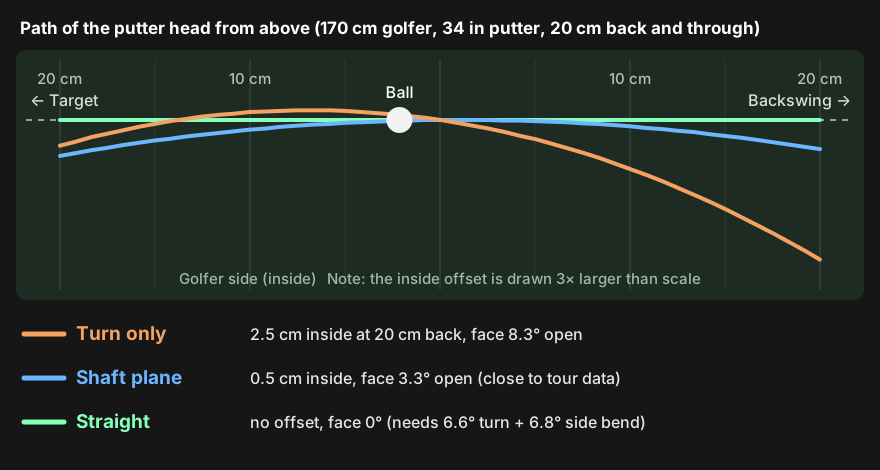
| With a shoulder turn only | About 2.5 cm inside at 20 cm back, with the face about 8° open (170 cm golfer, 34 in putter) |
| What tour players do | Most swing on an arc to the inside. Their face rotation almost matches the "swing along the shaft plane" calculation |
| Which is correct? | Any of them rolls the ball the same way if the face points at the target at impact. About 80% of directional scatter comes from the face angle |
| Effect of build | The more upright you stand, the further inside a turn-only stroke goes |
| Effect of grip | A conventional grip drops the trail shoulder and leans the stroke in-to-out. Cross-handed does the opposite |
Why turning alone is not straight
Your arms and shoulders hang from the rib cage, and the rib cage rotates around the spine. Stand upright and turn your shoulders, and your hands trace a level circle.
In putting you lean forward, so the axis of rotation, your spine, leans forward too. Rotating around a tilted axis moves the head in a tilted plane. Seen from directly above, that plane is not a line but an arc: the head comes inside, towards your body, both going back and going through.
For the head to move in a straight line seen from above, the axis must be horizontal, pointing from you towards the ball. What stands the spine axis up by the amount of your forward tilt is side bend: lead shoulder down and trail shoulder up going back, and the reverse going through, like a seesaw.
How much side bend you need follows from your forward tilt.
side bend ÷ turn = 1 ÷ tan (forward tilt of the upper back)
With 45° of tilt, side bend and turn are one to one. Someone standing more upright at 30° needs about 1.7 of side bend for every 1 of turn. The more upright you are, the more a straight stroke becomes a rocking motion rather than a turning one.
Three ways to move, in numbers
I used a typical set-up: a 170 cm golfer, a 34 in putter, and the left eye directly over the ball. In this set-up the upper back is tilted about 44° forward. The backswing is 20 cm.
| Shoulder motion | Off the target line | Face open | Turn | Side bend |
|---|---|---|---|---|
| Turn only (spine as the axis) | 2.5 cm inside | 8.3° | 11.6° | 0° |
| Shaft plane (plane tilted 70°) | 0.5 cm inside | 3.3° | 8.6° | 4.1° |
| Straight (vertical plane) | 0 | 0° | 6.6° | 6.8° |
"Face open" here is measured against the target line. In every case the face stays square to its own path. Nobody is opening the face with the wrists: if the head moves on an arc, the face direction changes by that much.
"Shaft plane" means swinging in the plane of the putter shaft, tilted at the lie angle (about 70°). The turn is roughly twice the side bend, and the head comes inside by only about 5 mm at 20 cm back. It looks almost straight, but it is a slight inside-to-inside arc.
Compared with measured tour strokes
The developer of the SAM PuttLab measuring system has published data from 99 PGA Tour players on 4 m putts.
| Measure | Tour average | This model |
|---|---|---|
| Face rotation through the 20 cm around impact | 3.2° | Shaft plane 3.3°, turn only 8.3° |
| Shape of the path | Most players arc to the inside on the backswing and the follow-through | Everything except "Straight" is an arc |
| Path direction at impact | 0.8° left (spread between players ±2.2°) | Shaft plane: 0.2° left |
| Attack angle at impact | 2.8° upward | 2.7° with the ball 5 cm ahead of the point under the eye |
The face rotation almost exactly matches the "Shaft plane" calculation. "Turn only" is more than double what was measured. Good putters are evidently not just turning their shoulders: they mix in side bend without thinking about it and swing close to the plane of the shaft. They are not perfectly straight either.
So how much does the path matter? A study of 71 elite players by the Norwegian researcher Karlsen and colleagues split the scatter in starting direction into its sources: face angle 80%, putter path 17%, impact point 3%. Whether the path comes slightly inside matters far less than where the face is pointing at impact.
How build changes it
The same "turn only" stroke goes inside by different amounts depending on how far you lean over. Your forward tilt is set by the combination of your height and your putter length.
| Height and putter | Upper-back tilt | Turn only: inside by | Turn only: face open | Side bend needed for straight |
|---|---|---|---|---|
| 155 cm, 34 in | 27° | 3.7 cm | 14.8° | 8.8° |
| 155 cm, 33 in | 35° | 3.1 cm | 11.9° | 8.3° |
| 170 cm, 34 in | 44° | 2.5 cm | 8.3° | 6.8° |
| 185 cm, 35 in | 51° | 2.1 cm | 6.4° | 5.7° |
| 185 cm, 34 in | 55° | 2.1 cm | 5.8° | 5.3° |
A shorter golfer with a longish putter stands more upright, and a turn-only stroke swings well inside. For that build a straight stroke needs about twice as much side bend as turn, which is why it tends to feel cramped. A tall golfer who bends over a lot gets close to straight with a turn alone.
The "Shaft plane" offset stays around 5 mm for every build, because that plane is set by the lie angle of the putter, not by the body.
Conventional versus cross-handed
On the grip, one hand sits below the other, and the shoulder on the low-hand side drops by that much.
For a right-hander with a conventional grip the right hand is low, so the right shoulder drops. In the model it ends up 4–5 cm lower than the left. When the shoulder line tilts, the spine axis leans slightly back (to the right) as well. Turning around that axis brings the head in low from the inside and out after impact.
| Grip | Low shoulder | Turn only: offset 20 cm back | Turn only: offset 20 cm through | Path at impact |
|---|---|---|---|---|
| Conventional | Right (about 4.6 cm) | 2.5 cm inside | 0.5 cm inside | 2.8° in-to-out |
| Cross-handed | Left (about 2.7 cm) | 0.6 cm inside | 2.3 cm inside | 2.3° out-to-in |
Cross-handed, the backswing becomes nearly straight and the head comes inside on the follow-through instead. Comments like "it is easier to take back cross-handed" or "my lead shoulder stopped lifting" can be explained by this change in shoulder height.
How much of the shoulder tilt turns into a lean of the spine differs from person to person, and the value used here is an assumption. The direction of the tendency is reliable; treat the size of the angles as a guide. And if you swing along the shaft plane or straight, the grip makes almost no difference to the path.
Your eye sees the backswing a little longer
One more calculation, for those who set backswing length against a marker. Even with the left eye over the ball, the top of the putter head is 2–3 cm above the ground and rises as you take it back. Against marks on the ground, it therefore looks as if you have taken it back slightly further than you really have.
| Backswing seen from above | 10 cm | 20 cm | 30 cm | 40 cm |
|---|---|---|---|---|
| Backswing as your eye sees it | 10.2 cm | 20.7 cm | 31.6 cm | 43.2 cm |
Up to 20 cm the difference is a few millimetres, but at 40 cm it looks about 3 cm longer. If you took a long putt back "to the marker" and still came up short, this may be part of the reason. The link between backswing length and roll distance is explained in "Putting distance control comes from stroke length".
Summary for players
- Do not be too strict about going straight back. A head that comes slightly inside is natural for the skeleton, and most tour players swing on an arc.
- If you focus on one thing, make it the face. About 80% of directional scatter comes from the face. Practising a square face at impact (a gate drill on short putts, for example) pays more than fixing the path.
- "Turn only" goes too far inside. If your hands crowd your body, add a little of the feeling of the shoulders trading places up and down, rather than turning more.
- If you want a straight stroke, bend over more or use a shorter putter. The more upright you are, the more side bend a straight stroke needs.
- Cross-handed changes the bias of the path. If your conventional stroke is strongly in-to-out, cross-handed may neutralise it.
- A long backswing is shorter than it looks. At 40 cm the difference is about 3 cm.
You can check your own height, arm length and putter length in Stroke Path by Body Build. It also lets you switch to left-handed, cross-handed and different ball positions.
Appendix: assumptions
Segment lengths come from ratios to body height (Winter's anthropometric table). The set-up is solved from three conditions: left eye over the ball, both hands on the grip, elbows bent 70°. The stroke is a pendulum: shoulders, arms, hands and putter rotate as one unit around a single axis through the centre of the shoulders, with the wrists, elbows, head and lower body kept still.
The difference in shoulder height is set to half of the tilt that would let both arms reach the grip at equal length, and the spine is assumed to lean towards the low shoulder by a quarter of that tilt. Both shares are assumptions, not measurements. A real stroke also has some wrist, elbow and head movement, so the numbers here show how much is decided by the way the shoulders move alone.
Sources: C. Marquardt, The SAM PuttLab: Concept and PGA Tour Data (2007, measurements of 99 PGA Tour players), J. Karlsen, G. Smith, J. Nilsson, The stroke has only a minor influence on direction consistency in golf putting among elite players (2008), D. A. Winter, Biomechanics and Motor Control of Human Movement (anthropometric ratios).