Golf, worked out in numbers
Turn a guess on the course
into a number you can trust
Physics-based golf calculators — how much a putt breaks, and how far each club really carries today — plus articles on the numbers behind them.
Tools
Tools that put numbers behind your decisions on the course. Everything is computed in your browser.
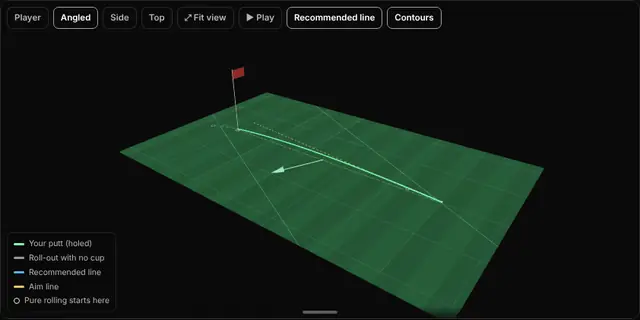
Putt Break Calculator
Works out how much a putt breaks, and the pace and aim that hole it, from the distance, slope and green speed. View the path in 3D and get the stroke most likely to go in.
- Putting
- 3D
- Physics
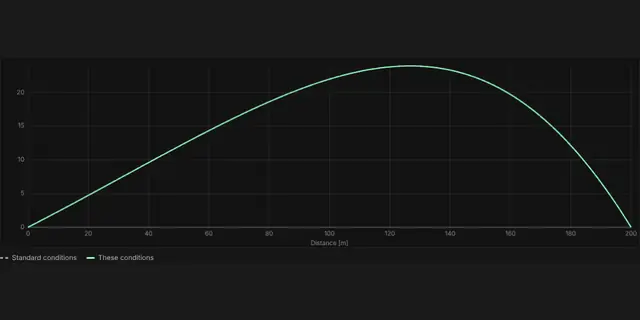
Carry Range Finder
Simulates the ball flight to show how much each club’s carry changes with temperature, altitude, pressure, humidity, wind and elevation — and which club it effectively plays like.
- Full swing
- Ball flight
- Wind & altitude
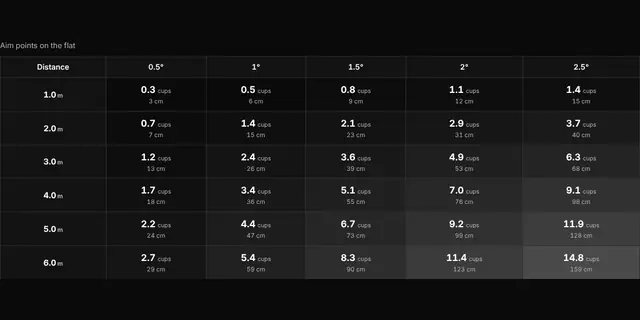
Break Chart
Turns green speed and slope into a table of aim points for every distance and side slope. Prints at a size that fits in a yardage book.
- Putting
- Chart
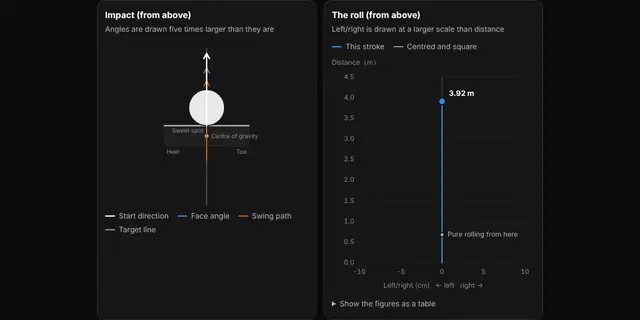
Putt Stroke Simulator
Computes the collision between head and ball from the stroke length and period, face angle, path and strike point, and from that how far the ball rolls. Compare what an off-centre strike costs with different putter types.
- Putting
- Impact
- Physics
Off-Green Putt Calculator
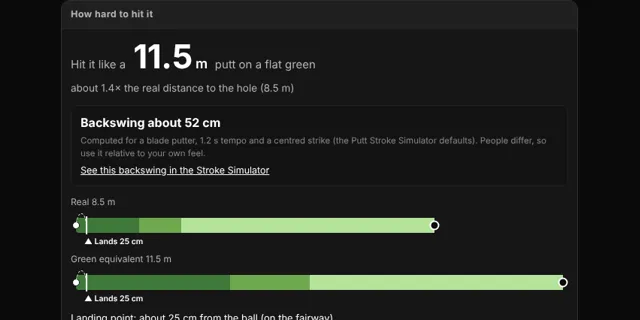
From the distance on fairway, fringe and green and how fast each grass rolls, works out how hard to putt from off the green — as a flat-green putt length and a backswing estimate.
- Putting
- Pace
- Fringe & fairway
Putting Stroke Path by Body Build
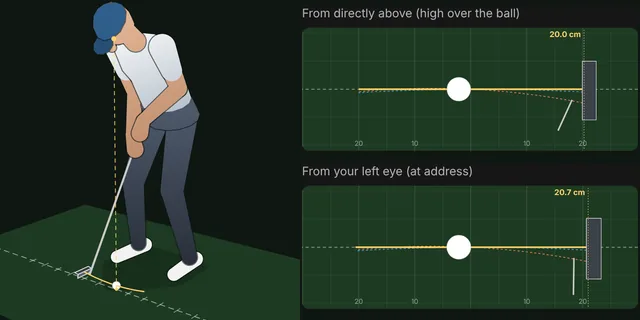
Builds a skeleton-like 3D model of your set-up from height, arm and putter length, and works out the head path for different shoulder motions. Compare the path from above with how your backswing looks to your eye.
- Putting
- Stroke
- 3D

Watch it on video
Short videos, under a minute each, showing how to use the calculators.
Blog
Notes on the physics of golf and the decisions it informs.
Can you really take the putter straight back? The stroke path your skeleton allows, checked against tour data
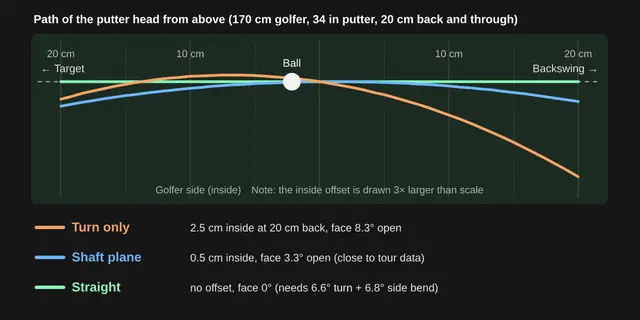
You may be trying to go straight back and straight through, but when you lean over the ball and turn your shoulders, the putter head moves on an arc to the inside. A skeleton model shows a shoulder turn alone goes 2.5 cm inside at 20 cm back, and a straight path needs about as much side bend as turn. This article compares that with measurements of 99 PGA Tour players, shows how build and grip change it, and what to do with it in practice.
- Distance & pace
How much does the golf ball really matter? Tour (spin) balls vs distance balls, tested with physics and robot data
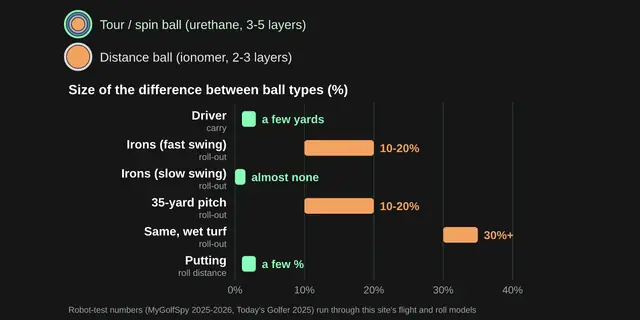
How much do your shots and putts change between a tour ball (urethane cover) and a distance ball (ionomer cover)? Instead of marketing claims, we used robot-test numbers from 2025-2026 and this site's flight and roll models. The difference is large on short pitches and from wet turf, and small for slower swingers' drivers and irons, and on putts.
- Full-swing yardage
Is AimPoint physically correct? Testing the finger method with a ball-roll model
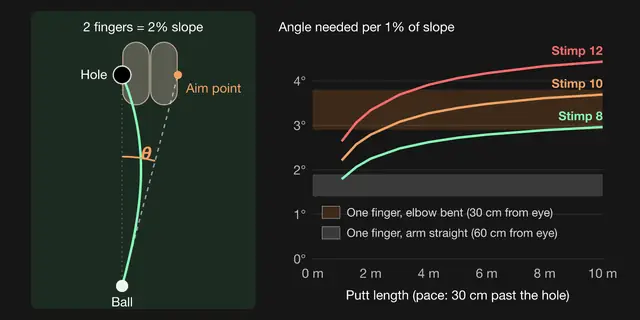
AimPoint has you feel the slope with your feet and pick an aim point with your fingers. We summarise how the method is taught on various sites, then use a ball-roll model to check whether the finger angle is physically right. The answer: the idea is sound, but the angle one finger should cover changes a lot with green speed, and one finger at arm's length is not enough. We also cover how to get more precise, how to correct for differences in finger width and arm length, and the main criticisms of AimPoint, from a neutral point of view.
- Greens & ball roll
Flagstick in or out when putting? A physics model gives the answer
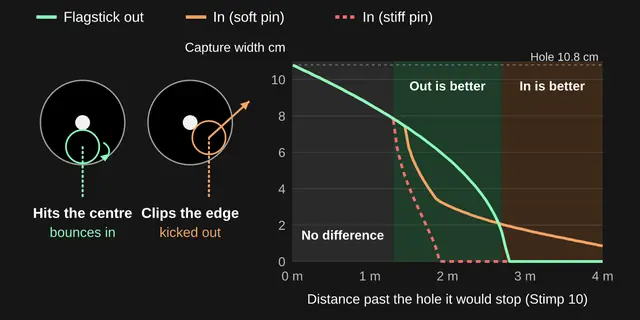
Since the 2019 rule change you can putt with the flagstick left in. Some say it helps you hole more putts, others say it costs you. We worked it out from the condition for a ball to drop into the hole and from how the ball rebounds off the pin. The answer: at normal pace it makes almost no difference, so take it out if in doubt. Leaving it in only pays when a putt that is far too fast hits the pin dead centre. The common advice to take it out on uphill putts also turns out to be physically correct.
- Distance & pace
How to make your putting distance more consistent: measure your spread as a percentage, then remove the causes one by one
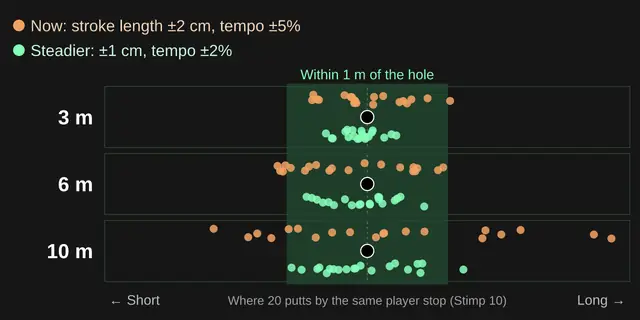
You hit the same putt and the ball stops somewhere different every time. Splitting the causes apart with a physics model shows that on short putts most of the spread comes from stroke length, and on long putts from tempo. Drawing on coaches and data published at home and abroad since 2024, this article shows how to measure your own spread and the order in which to practise to reduce it. It also estimates, by level of player, how many strokes this saves over 18 holes.
- Distance & pace
New putters of 2025–2026 compared: what the top tour players use, and how to find the one that fits you
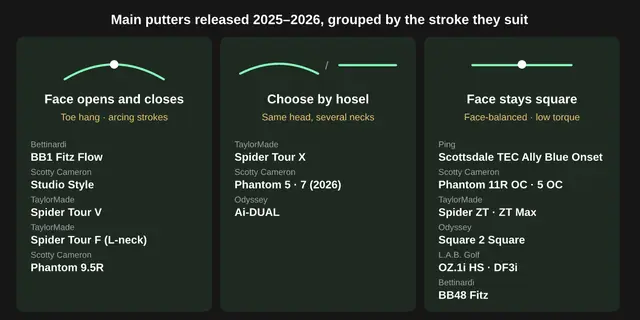
The main new putters released in 2025 and 2026, compared by head shape, hosel and the stroke they suit. Where we could confirm it, we list the top-ranked men's and women's tour players who use each one. At the end, a step-by-step way to narrow it down to the putter that fits you.
- Putters & gear