New putters of 2025–2026 compared: what the top tour players use, and how to find the one that fits you
- Putters & gear
A lot of new putters came out between 2025 and 2026. The most visible trend is the spread of "zero torque" and "onset" designs, built so the face resists twisting. Yet most of the players winning on tour still use mallets and blades of familiar shapes.
This article lines up the main models released in 2025–2026 by shape, hosel and the stroke they suit, and adds the top-ranked players who use them. Player putters are only those we could confirm in 2026 WITB (What's In The Bag) coverage; where we found no one, no player is listed.
The physical difference between putter types (blade vs mallet) is calculated in "Choosing the right putter". This article follows on from it: its job is to help you decide which of the actual new models to try.
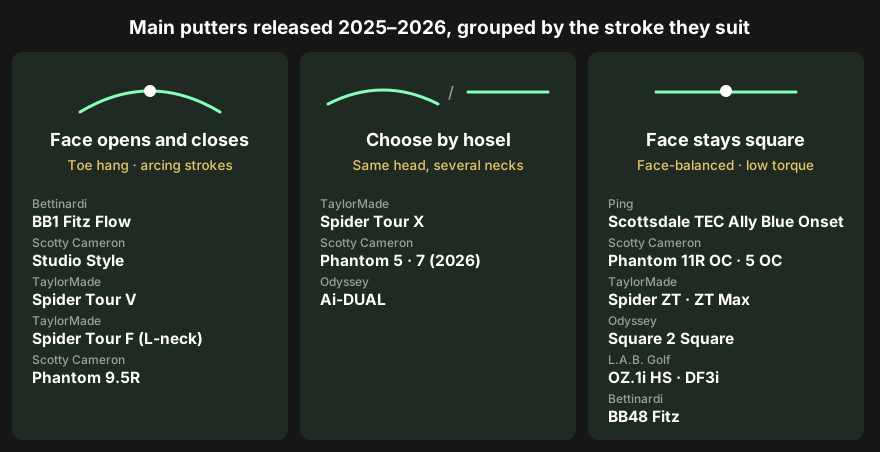
The short answer
| If you… | Try these first | Why |
|---|---|---|
| Have an arcing stroke and like blades | Bettinardi BB1 Fitz Flow, Scotty Cameron Studio Style | Toe-hang hosels that go with the face opening and closing |
| Arc the stroke but want off-centre forgiveness too | Spider Tour V, Phantom 9.5R | Mallets with toe hang, somewhere in between |
| Want to go straight back and straight through | Spider Tour (double bend), Phantom 7 DB | Face-balanced large mallets |
| Flip or open the face under pressure | Phantom 11R OC, Ping Scottsdale TEC Ally Blue Onset, zero-torque models | Centre of gravity close to the shaft line, so the head resists twisting |
| Struggle to aim the face at address | Odyssey Ai-DUAL (1/2 Ball), Spider Tour X | Lines and shapes that make aiming easier |
The most important point is this:
The model a tour player uses is not necessarily the one that suits you. A tour player's putter is a tour build, made to their own length, weight and hosel, and is usually not the same as the one in the shop. Read the player names as a hint about what kind of stroke each putter suits.
Three things to understand before choosing
New putter marketing is full of jargon, but when choosing you only need to look at three things.
1. Hosel (toe hang): match it to your stroke
Balance a putter horizontally on one finger. On some, the toe drops; on others, the face points straight up. The first is called "toe hang", the second "face-balanced".
- If your stroke arcs, a toe-hang putter tends to suit you
- If you go straight back and straight through, a face-balanced putter tends to suit you
To see which you are closer to, enter your height and putter length in Stroke Path by Body Build (the reasoning is in "Can you really take the putter straight back?").
In an arcing stroke, the face opens on the backswing and closes into impact. A toe-hang putter already wants to rotate that way, so it doesn't fight the motion. The same head can have very different toe hang with a different hosel, so most new lines offer several hosels for one shape.
2. Head size: forgiveness on off-centre hits
The bigger the head, and the more its weight sits at the edges, the less distance you lose on an off-centre hit. In our physics model, a 6 m putt struck 2 cm off centre came up about 46 cm short with a blade and about 22 cm short with a large mallet (details of the calculation).
But the same article also found that switching putter type adds only about 0–2 percentage points of holed putts. Face-angle errors matter about four times as much as contact errors, so a head that helps you aim often does more than a "forgiving" head.
3. Zero torque and onset: the new trend of 2025–2026
When the head accelerates during the stroke, the offset between the centre of gravity and the shaft line creates a force that twists the head (torque). The more toe hang, the larger this force.
Zero torque puts the centre of gravity on the line of the shaft, bringing that twisting force close to zero. Onset puts the shaft just in front of the centre of gravity (or on the same line), keeping the twist small while looking closer to a traditional putter.
Both are for players who don't want to rotate the face themselves. If you play by opening and closing the face, they may not suit you, because they won't come back on their own.
Comparison table
| Model (released) | Stroke it suits | Main players |
|---|---|---|
| TaylorMade Spider Tour series (Jun 2026) | Choose by hosel | Scheffler, McIlroy, Rai and others |
| TaylorMade Spider ZT (Jun 2025) / ZT Max (Jun 2026) | Straight | — |
| Scotty Cameron Phantom 2026 (Feb 2026) | Choose by hosel | — |
| Scotty Cameron Phantom 9.5R (Aug 2026) | Arcing | Cameron Young |
| Scotty Cameron Phantom 11R OC (Oct 2025) | Straight | Haeran Ryu |
| Scotty Cameron Studio Style (Mar 2025) | Arcing | — |
| Ping Scottsdale TEC Ally Blue Onset (Mar 2026) | Straight | Wyndham Clark |
| Bettinardi BB1 Fitz Flow / BB48 Fitz (May 2026) | Arcing / straight | Fitzpatrick |
| Odyssey Ai-DUAL / Square 2 Square (Jan 2026) | Both / straight | — |
| Odyssey Square 2 Square Tri-Hot (Oct 2025) | Straight | — |
| L.A.B. Golf OZ.1i HS (Aug 2025) / DF3i (Jan 2026) | Straight | J.J. Spaun |
Release (or announcement) months are for the US. Release dates and prices in other countries may differ. Men's world ranks are from the Official World Golf Ranking (OWGR) for the week of 20 October 2026; women's are from the Rolex Rankings of 12 October 2026.
Each model and who uses it
TaylorMade Spider Tour series (2026)
Released June 2026. Four shapes, Spider Tour, Tour X, Tour V and Tour F, with a new "torched" finish that looks flame-treated. US price $349.99 (Golf.com).
| Shape | CG depth | Hosel and character |
|---|---|---|
| Spider Tour | 36 mm | The highest-MOI shape |
| Spider Tour X | 34–36 mm | Choice of three hosels (including an L-neck) |
| Spider Tour F (new shape) | 22 mm | L-neck or double bend (face-balanced) |
| Spider Tour V (new shape) | 21 mm | The most compact. L-neck only, for arcing strokes |
The Spider Tour and Spider Tour X keep their shapes; only the finish is new. Their tour record is in a class of its own: in the 2026 PGA Tour FedEx Cup season (37 events), Spider Tour-family putters won 13 times, 11 of them with the Spider Tour X (Golf.com count).
Main players
- Scottie Scheffler (world No. 1): Spider Tour X with an L-neck. Three wins in 2026. The 2026 range also has an L-neck version
- Rory McIlroy (2): Spider Tour X. Won the 2026 Masters (Golf.com WITB)
- Chris Gotterup (6): Spider Tour X. Three wins in 2026
- Collin Morikawa (11): won in 2026 with a Spider Tour X. Also gave input on the Tour F
- Aaron Rai (17): Spider Tour V. Won the 2026 PGA Championship (Golf.com)
Win counts are from the Golf.com count above.
Who it suits: anyone who wants large-mallet forgiveness. The hosel changes its character a lot, so choose to match your stroke. As a guide, arcing players should look at the Tour V or the L-neck Tour F, and straight-stroke players at the double-bend Spider Tour.
TaylorMade Spider ZT / Spider ZT Max
The Spider ZT was released in June 2025, TaylorMade's first zero-torque putter (Golf.com). Its shaft lean is only 1°, so it works with ordinary grips. The Spider ZT Max was released in June 2026: a larger head, with weights in the four corners to raise MOI. The ZT Max starts at $449.99 in the US (Golf Digest).
We found no top-ranked player using either of them week to week in 2026 (on the women's side, Haeran Ryu used a TaylorMade zero-torque putter (5K ZT) in the first round of the KPMG Women's PGA, then switched to the Phantom 11R OC below from the second round).
Who it suits: players who don't want to rotate the face and want to go straight back and straight through.
Scotty Cameron Phantom (2026)
Released February 2026 (pre-orders from 20 January, in shops from 27 February). A rebuilt mallet line in three shapes, the Phantom 5, 7 and 9R. US price $499 (Golf.com). Every model has a carbon-steel face insert (Studio Carbon Steel).
The same shape comes with different hosels, which change its character:
- 5 / 7 / 9R (mid-bend or double-bend shafts): close to face-balanced
- 5.2 / 7.2 / 9.2R (plumber's neck): a little toe hang
- 5.5 / 7.5 (jet neck): the most toe hang
- 5 OC ($549): low-torque version with the shaft on the same line as the centre of gravity
We found no top-ranked player winning with the 2026 version. Russell Henley (8) won the Charles Schwab Challenge in May 2026 with a Scotty Cameron mallet, but it was a tour prototype of the older Phantom X5 (GolfWRX WITB). The new sole of the 2026 version was shaped with input from Justin Thomas.
Who it suits: players who want a mallet but want to fine-tune the hosel to their stroke.
Scotty Cameron Phantom 9.5R
Released 25 August 2026 (pre-orders; $549 in the US). This is the shape Cameron Young was using on tour, put on sale as it is (AmateurGolf.com). During 2025, Young switched from a plumber's neck to a jet neck on the same 9R head. He has explained that, with the face rotating a little more, the centre of the face is easier for him to see (Dormie). In other words, it is a mallet for players who still want to feel the face open and close.
Main players
- Cameron Young (4): won the 2026 Players Championship and the Cadillac Championship with the tour version of this putter (Players WITB)
Who it suits: players with an arcing stroke who want a bigger head than a blade to aim with.
Scotty Cameron Phantom 11R OC (and Studio Style Fastback OC)
Announced October 2025. "OC" (Onset Center) means the shaft sits on the same line as the centre of gravity to reduce twisting (GolfWRX). The head is 15 g heavier than a standard Scotty Cameron. US price $549. A Fastback OC based on the Studio Style shape came out at the same time.
Main players
- Haeran Ryu (women's No. 3): at the 2026 KPMG Women's PGA Championship, she switched from a TaylorMade 5K ZT after the first round to the Phantom 11R OC and won her first major (Golf Monthly)
Who it suits: players interested in the zero-torque idea who still want something that looks like a traditional Scotty Cameron.
Scotty Cameron Studio Style (2025)
Released March 2025. Twelve models, centred on Newport (Anser-style) blades plus mid-mallets such as the Fastback and Squareback (Golfalot). A carbon-steel face insert softens the feel. US retail prices are around $499.
We found no top-ranked player using it in competition in 2026, because tour players' blades are usually personal prototypes.
Who it suits: players with an arcing stroke who judge distance by feel and sound.
Ping Scottsdale TEC Ally Blue Onset
Released March 2026. An "onset" mallet with the shaft just in front of the centre of gravity, part of the Scottsdale TEC line (bunkered). It has Ping's "Eye-Q" alignment, designed to settle your gaze. Unlike a zero-torque putter, it leaves a little room for the head to twist.
Main players
- Wyndham Clark (5): won the 2026 CJ Cup Byron Nelson, U.S. Open and BMW Championship with it. It was the first men's major won with a Ping putter since Bubba Watson at the 2014 Masters
Clark's putter is a heavy counterbalanced build, with a head of about 400 g and a length of 38 inches (Golf.com). He started with a standard-length version in March and moved to the counterbalanced build at the RBC Heritage in April. His stroke is covered in more detail in "The putter of every player in the world top 20".
Who it suits: players whose hands take over under pressure and close the face, and who want a putter that looks like a normal mallet.
Bettinardi BB1 Fitz Flow / BB48 Fitz
Released 8 May 2026. Two putters developed with Matt Fitzpatrick, $550 each in the US (Bettinardi announcement). Both are milled from 303 stainless steel, with a 350 g head.
- BB1 Fitz Flow: a blade with a thin topline and a short flow neck. For a moderate arc
- BB48 Fitz: a symmetrical, face-balanced mallet. For straight or slightly arcing strokes
The centre of the face has a semi-circular milling pattern.
Main players
- Matt Fitzpatrick (3): the tour BB1 Flow that the BB1 Fitz is based on. Won the 2026 Valspar Championship, RBC Heritage and Zurich Classic (team event with his younger brother Alex) (Bettinardi)
Who it suits: blade players who want to feel the face open and close (BB1); players who want blade-like feel with face balance (BB48).
Odyssey Ai-DUAL / Ai-DUAL Square 2 Square
Released 23 January 2026 (GolfMagic). An AI-designed two-layer insert (soft outside, firm inside) aimed at reducing the variation in ball speed on off-centre hits. You can choose "1/2 Ball" alignment, which frames half a ball; in testing Odyssey ran with researchers from Clemson and Baylor, golfers holed an average of 1.13 more putts out of 10 from 6 feet than with traditional alignment (Callaway announcement). Bear in mind that the manufacturer was involved in the test and that it covered only 6-foot putts. There are many shapes from blade to mallet, including the zero-torque Ai-DUAL Square 2 Square.
We found no top-ranked player using it in competition in 2026.
Who it suits: players who struggle to aim at address (1/2 Ball), and anyone who wants to compare different shapes with the same insert.
Odyssey Square 2 Square Tri-Hot
Announced October 2025. A zero-torque putter that combines aluminium, steel and tungsten, with the centre of gravity moved towards the face (GolfWRX). With the centre of gravity further forward, the shaft can sit closer to the face.
We found no top-ranked player using it in competition in 2026.
Who it suits: players who want to try zero torque in a familiar Odyssey shape such as the Rossie.
L.A.B. Golf OZ.1i HS / DF3i
L.A.B. Golf is the pioneer of zero torque (it calls it "Lie Angle Balance").
- OZ.1i HS (released August 2025, $499 in the US): L.A.B. Golf's first heel-shafted model (Golf.com). It looks closer to a traditional mallet while keeping zero-torque behaviour
- DF3i (announced January 2026, in shops from 27 February, $499 in the US): the classic DF3 with a stainless-steel face insert for a firmer feel (GolfWRX)
Main players
- J.J. Spaun (12): OZ.1i HS. He won the 2025 U.S. Open with a DF3 and switched to the OZ.1i HS at the Charles Schwab Challenge in May 2026 (GolfWRX)
Who it suits: players who don't want to rotate the face. If you dislike the look of a centre shaft, the OZ.1i HS.
What the 2025–2026 putters tell us
Zero-torque and onset designs have multiplied fast. TaylorMade, Scotty Cameron, Odyssey and Ping have all released putters of this kind.
Yet among the top-ranked players, only Spaun or so uses a true zero-torque putter. Most of the winners use long-established mallet and blade shapes, matched to their stroke through the hosel. Scheffler's L-neck, Young's jet neck and Rai's L-neck Spider Tour V are examples.
There are also players, like Clark, who switched to a low-torque design mid-season and won. Ryu switched from a zero-torque putter to the low-torque Phantom 11R OC during a tournament and won it. When the new designs suit someone, they clearly work. Whether they suit you depends on your stroke, not on the trend.
How to narrow it down to one putter
Step 1: find out the shape of your stroke
Film your stroke with your phone from directly above (or from the front). You'll see whether the head moves on an arc or in a straight line. On the practice green, moving the head along a straight line (a chalk line or a seam) is another way. Many people who think they go "straight" actually arc.
Step 2: pick two or three candidates with a hosel that fits your stroke
| Stroke | Candidates |
|---|---|
| Clear arc | BB1 Fitz Flow, Studio Style (Newport), Spider Tour V and Tour F (L-neck), Phantom 9.5R, 5.5, 7.5 |
| Slight arc | Phantom 5.2, 7.2, 9.2R (plumber's neck) |
| Nearly straight | Spider Tour (double bend), Phantom 7 DB, BB48 Fitz, Ping Scottsdale TEC Ally Blue Onset |
| Don't want the face to rotate at all | Phantom 11R OC and 5 OC, Spider ZT, Square 2 Square, L.A.B. Golf |
Step 3: address it and see whether you aim it square
In the shop, set up, aim the face at a target, and have someone check the aim from behind. Aim errors affect your holing rate more than contact errors do. Some people aim better with more lines, others with none. This isn't physics; it's how the putter matches your eyes.
Step 4: hit ten balls to the same distance and compare the spread
Hit ten balls each from 3 m and 6 m. The putter with the smallest spread of finishing positions suits your stroke. You'll also find out whether you like the feel. Some people find soft inserts so quiet that distance is hard to judge.
Step 5: fit the length, lie and weight
Finally, match the length and lie angle to your setup. Tour players' putters work because they are fitted this far. The same model at the wrong length is a different putter.
Practical summary
- Look at the hosel before the brand. Choose to match the shape of your stroke
- Zero torque and onset are for players who don't rotate the face. They may not suit players who open and close it
- Read a tour player's model as a hint about the kind of stroke it suits
- In the shop, compare how square you aim and how much ten putts spread
- Switching putters adds very few holed putts on paper. Not putting up with a putter that doesn't fit you matters more
You can try how changing a putter's weight or MOI changes the roll with your own stroke in the Putt Stroke Simulator. How to build distance control itself is covered in "Putting distance control comes from stroke length".
Sources: manufacturer announcements and product articles and WITB coverage from Golf.com, GolfWRX, Golf Digest, Golf Monthly, Golfalot and others (checked up to October 2026). The main statements link to their sources in the text. 2026 PGA Tour winning-putter counts are from Golf.com's count (14 September 2026, end of the FedEx Cup season), men's world ranks from the Official World Golf Ranking (OWGR) for the week of 20 October 2026, and women's world ranks from the Rolex Women's World Golf Rankings (12 October 2026). Prices are US prices at launch; where we could not confirm a manufacturer price, they are retailer prices. Players change putters during the season, so the current situation may differ.