Choosing the right putter: blade vs mallet, by stroke, build and personality
- Putters & gear
The usual putter advice goes something like "if they won't drop, switch to a mallet" or "good players use blades". But there are misses a putter's shape fixes and misses it doesn't. Switch without knowing which is which and, while you get used to a putter that doesn't suit your eye, you may hole even fewer.
This article compares blades, mid-mallets and large mallets using the same physics model as the Putt Stroke Simulator, and looks at which type suits which golfer from three angles: stroke shape, build, and personality (habits). The explanation with formulas is collected in the appendix at the end.
The short answer
| If you... | Putters that tend to suit | Why |
|---|---|---|
| Swing on an arc | Blades, toe-hang models | They go with the face opening and closing |
| Go straight back and straight through | Face-balanced mallets | The face resists turning and stays square more easily |
| Hit the centre some times and miss it others | Large mallets | Distance lost on off-centre hits is about half a blade's |
| Struggle to aim square at the target | Mallets with alignment lines | Face-angle misses count about four times as much as contact misses |
| Judge distance by feel and sound | Blades | Off-centre hits come back clearly through the hands |
| Get handsy or quicken the tempo under pressure | Heavier mallets, thicker grips | They work against hand action (mostly a matter of feel) |
The most important result, though, is this:
Changing putter type adds roughly 0 to 2 percentage points of holed putts in the calculation. Much larger are the spreads in face angle and tempo. That is why the quickest route is not "the physically most forgiving putter" but "the putter you aim consistently and swing with good rhythm".
The rest of the article shows the evidence for this conclusion.
The three putter types in numbers
There are countless putter shapes, but physically they are described well by three numbers.
| Type | Head weight | Moment of inertia | CG depth |
|---|---|---|---|
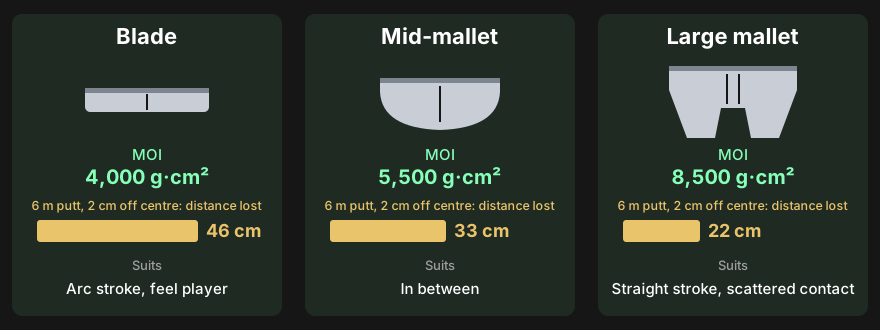
| Blade (including Anser-style) | ~345 g | ~4,000 g·cm² | ~12 mm |
| Mid-mallet | ~355 g | ~5,500 g·cm² | ~22 mm |
| Large mallet | ~365 g | ~8,500 g·cm² | ~35 mm |
Moment of inertia (MOI) is resistance to twisting when you miss the centre. It grows as head weight is spread outward (to the toe, the heel and the back). CG depth is the distance from the face to the centre of gravity. Large mallets carry weight at the back, so it is deep. The values are typical for each type, not those of any particular model.
Here is how those three numbers show up in the ball.
Off-centre hits lose distance (half as much with a mallet)
Keeping the stroke for a 6 m putt, only the contact point was moved toward the toe (Stimp 10, flat).
| Contact point | Blade | Mid-mallet | Large mallet |
|---|---|---|---|
| 1 cm off | 12 cm short | 10 cm short | 6 cm short |
| 2 cm off | 46 cm short | 33 cm short | 22 cm short |
With a large mallet, the distance lost on off-centre hits is about half a blade's. Missing toward the heel leaves the ball short by almost the same amount.
Direction error from off-centre hits does not shrink with a mallet
The surprise is sideways. Missing the centre by 2 cm on the same 6 m putt, the ball finished about 4.4 cm off line with the blade and about 5.9 cm with the large mallet. The mallet is slightly worse.
An off-centre hit twists the head, and the face slides sideways across the ball, changing its direction (gear effect). This error is proportional to "CG depth ÷ moment of inertia". A large mallet has a bigger MOI but also a deeper CG, so the two cancel out. "With a mallet, off-centre hits still go straight" is, according to the calculation, true for distance and not true for direction (CG depth is estimated from the shape, so it varies between models).
Face angle, not contact point, sets the direction
So what decides direction misses? Assuming an average golfer, the sideways spread on a 3 m putt was split by cause. The ball is struck to roll 40 cm past the hole, and the figure is the spread (standard deviation) of the sideways error at the hole.
| Source of miss (size of spread) | Blade | Large mallet |
|---|---|---|
| Face angle (±1°) | 4.5 cm | 4.5 cm |
| Contact point (±8 mm) | 1.0 cm | 1.2 cm |
The hole's radius is 5.4 cm. Almost all direction error comes from face angle. The contact point contributes about a quarter as much, and the difference between putter types is smaller still.
Face angle is not something the putter type changes physically. What it can change is how easily you aim it at the target at address and whether the face turns on its own during the stroke. Those are questions of "how it looks" and "how it matches your stroke", and the answer differs from person to person.
Tempo sets the distance
Distance spread was split by cause in the same way (3 m, struck to roll 40 cm past).
| Source of miss (size of spread) | Blade | Large mallet |
|---|---|---|
| Tempo (±4%) | 29 cm | 29 cm |
| Contact point (±8 mm) | 6 cm | 3 cm |
The biggest distance miss is the spread in tempo (how fast you swing through the same length). A 4% variation in tempo alone spreads distance by almost 30 cm. A large mallet halves the distance error from contact, but that is a small part of the whole.
How many more putts does a different putter hole?
Combining the spreads in face angle, contact point and tempo, the holing rate was calculated over thousands of putts. It is a "stroke only" estimate that leaves out bumps on the green and misreads.
- Golfers with steady contact, face angle and tempo: almost no difference between blade and large mallet
- Average golfers: no real difference at 3 m; at 6 m the large mallet is about 1.5 points better
- Golfers with scattered contact: at 3 m the large mallet is about 2 points better, at 6 m and 10 m about 1 point
The difference between putter types is 0 to 2 points. It is true that most tour players use mallets (16 of the top 20 in "I checked the putters of the world's top 20"), but that is a world where small edges like this are added up. For ordinary golfers, aiming consistently and swinging with good rhythm matters many times more.
With that in mind, here are three angles on who suits what.
Angle 1: choose by stroke shape
Arc strokes and straight strokes
Putting strokes fall broadly into two kinds.
- Arc: the stroke is driven by turning the body, so the head travels on a gentle arc; the face opens going back and closes coming through
- Straight: the head goes straight back along the target line and straight through; the face keeps looking at the target
To find out which you are, lay a club along the target line on the practice green and stroke over it. If the head moves inside as you take it back, you have an arc stroke.
Toe hang and face balance
This is where toe hang comes in. Balance the shaft horizontally on a finger: if the face points straight up, the putter is face-balanced; if the toe droops, it has toe hang.
The difference is where the CG sits relative to the line of the shaft. A face-balanced putter has its CG on the shaft line, so little twisting force acts on the head during the stroke and the face tends to hold its angle. A toe-hang putter has its CG off the shaft line, so when swung the face opens and closes more readily.
- Arc strokes tend to suit toe-hang putters (most blades and Anser-style heads). They don't fight the face's natural rotation, so the hands have less correcting to do
- Straight strokes tend to suit face-balanced putters (most mallets). A stroke that doesn't rotate the face matches a head that resists rotating
Pair them the other way round and you end up using your hands somewhere in every stroke to fix the face. As calculated above, a 1° face error on a 3 m putt puts the ball about 4.4 cm off line at the hole. With a hole radius of 5.4 cm, the tolerance for face angle is barely 1°. How well the head suits your stroke decides whether you can stay within it.
This twisting force is largest while the head is speeding up or slowing down, and in a pendulum stroke it falls to almost zero at impact (the bottom of the arc). Toe hang shows up when the face turns around the transition and does not fully come back. The steadier your tempo, the less toe hang matters.
If your contact point wanders
Golfers whose contact point is not the same each time get the most from a large mallet. Calculating the part of long-putt distance spread that comes from contact (6 m, contact spread ±12 mm) gave about 18 cm for a blade and about 9 cm for a large mallet, half as much. If "my long putts never finish the right distance" or "I three-putt a lot" sounds familiar, it is the first thing worth trying.
You can check your contact point by drawing a line around the ball's equator with a water-based pen; it leaves a mark on the face.
Angle 2: choose by build
Height and arm length: get the length right first
The first thing to fit to your build is not the head shape but putter length. If the length is wrong, your spine angle and eye position change every time, and aiming won't settle either.
Most putters on sale are 33 to 35 inches. A guideline often used in fitting is:
| Height | Length guideline |
|---|---|
| Under 165 cm (5'5") | 32–33 in |
| 165–180 cm | 33–34 in |
| Over 180 cm (5'11") | 34–35 in |
People of the same height still differ with arm length and setup. Three checks:
- With your arms hanging naturally from the shoulders, do your hands arrive at the grip without reaching?
- Are your eyes directly over the ball or slightly inside it (toward your body)?
- At address, is the middle of the sole on the ground (toe and heel not lifted)?
A wrong lie angle affects direction less than you'd think
The third check is about lie angle. With irons, a lie error throws direction off badly; with a putter, much less so. A putter has only about 3° of loft, so even with the toe 5° up, the face aims only about 0.26° differently, about 1 cm at the hole on a 3 m putt.
It is still worth fitting the lie for a repeatable setup. A toe-up address lifts a little differently each time, and eye position and posture move with it. That variation is a bigger problem than the 1 cm itself.
Big or strong: choose head weight by feel
Strong players are often said to like heavy putters. What does physics say? For the same stroke length, head weight changes distance only slightly.
| Head weight | Distance for the same stroke | Backswing for 6 m |
|---|---|---|
| 320 g | 5.9 m | 36.6 cm |
| 345 g | 6.0 m | 36.3 cm |
| 370 g | 6.1 m | 36.0 cm |
| 400 g | 6.2 m | 35.7 cm |
Between 320 g and 400 g, the backswing needed differs by about 1 cm. And the extra distance when the tempo is 5% quicker (about 10%) was the same regardless of head weight. A heavy head does not steady the roll of the ball.
Some players still suit a heavy head because many feel that a heavier head is harder to flick with the hands and easier to swing at a relaxed tempo. That is the fit between body and equipment, which a physics model cannot calculate. If a light head makes your tempo quick, a heavier head or a counterbalanced putter (with weight in the grip end too) is worth trying.
Hand size and wrist action: grip thickness
Thick grips are often recommended for golfers with large hands or who use their wrists. A thick grip spreads grip pressure and is said to keep the wrists from breaking down. Results vary a lot between people, so it is best treated as something to try if you feel your wrists flip through impact with a thin grip.
Angle 3: choose by personality (habits)
As far as I could find, no study has directly examined the match between personality and putter type. What follows links the ways personality shows up as habits in the stroke to the numbers calculated above.
Impatient, or quicker under pressure
The biggest distance miss was tempo. If your tempo tends to speed up, practising a steady tempo helps more than choosing a putter. If you do choose equipment for it, a heavier head or a thicker grip, both harder to flick with the hands, can help calm the tempo.
Careful, detail-minded (the analytical type)
If you want to set up and strike the same way every time, a face-balanced mallet with alignment lines is likely to suit. Most direction error comes from face angle, so the more cues you have to square up at address, the better. The shape also works well with lining up a line drawn on the ball with the putter's line.
Playing by feel (the feel type)
If you judge distance by feel and sound, a blade may suit you. Because it loses more distance off centre, mistakes come back clearly to your hands and in the result. If you can pick that up in practice and make your contact more consistent, the blade's lack of forgiveness becomes information.
Afraid of short putts, or the hands move on their own
If your hands jump on short putts, one approach is to let the head's properties damp the hand action. A face-balanced large mallet, a heavier head, a thicker grip and counterbalancing all point that way. If none of that helps, there are ways to change the setup itself, such as a long putter or an "arm-lock" grip that rests the grip along the forearm.
Can't aim at the target at address
If the face points right or left of target at address, the quickest route is to find a putter whose lines look right to you. A single line, two lines, a ball-width line, a T shape: how putters look varies a lot. Which one works is personal, so set up to a straight 2 m line on the practice green and have someone check your aim from behind.
Common questions
Insert or milled face?
The face material mainly changes rebound and feel and sound. Calculated with a coefficient of restitution between 0.78 and 0.88, the same stroke rolls about 10% further at 0.88 than at 0.78, and the backswing needed for 6 m differs by about 2 cm. The physical difference is small, so choose by the feel you prefer. If fast greens leave you with a backswing so small it feels scary, a softer insert that needs a slightly longer stroke is one option.
Should good players use a blade?
There is no reason they should. In the calculation above, for golfers with steady contact, face angle and tempo, there was almost no difference between blade and large mallet. The better you are, the smaller the difference equipment makes, that is all.
Summary
- What the putter type mainly changes is distance on off-centre hits. A large mallet loses about half as much as a blade
- Direction error from off-centre hits does not shrink with a mallet (because the CG is deep)
- Most direction error comes from face angle, most distance error from tempo. The difference between putter types is 0 to 2 points of holing rate
- So choose by fit rather than forgiveness: match toe hang to your stroke shape, length to your build, and weight, grip and lines to your habits
- If your contact wanders or your long putts never finish the right distance, try a large mallet first
You can enter numbers close to your own putter (head weight, MOI, CG depth) in the Putt Stroke Simulator and see what happens on an off-centre hit or an open face. How to build distance control itself is covered in "Putting distance control comes from stroke length".
Appendix: calculation details
The rest explains the numbers in the article with formulas.
Ball speed on off-centre hits
The head and ball are treated as rigid bodies and the collision is solved in 3D. In a simple form that ignores CG depth, missing the centre by d gives a ball speed of
(1 + m/M) / (1 + m/M + m d² / I) times
that of a centre strike (m = ball mass 45.9 g, M = head weight, I = moment of inertia). Distance falls with the square of ball speed, so doubling d makes the distance loss about four times as large. That is why the 1 cm and 2 cm rows in the table differ by nearly four times. Double I, and the loss roughly halves.
Direction on off-centre hits (gear effect)
An off-centre hit twists the head, and because the face is in front of the CG, the contact point moves sideways and rubs the ball. The resulting change in start direction is roughly
Δθ ≈ (2/7) × m × d × c / I [rad]
(c = CG depth). It is proportional to c / I (CG depth ÷ MOI), so in a large mallet, where c grows along with I, the error does not shrink. The model's values broadly match a report that measured 10 brands on a pendulum test rig (about 0.034° per mm).
Face angle and direction
With face angle F and path P, the start direction is roughly
start direction ≈ 0.83 F + 0.17 P
so the face decides more than 80% of it. At 3 m, F = 1° puts the ball about 4.4 cm off line at the hole.
Toe hang and twisting force
If r is the distance from the shaft line to the CG, then when the head accelerates at a, the moment twisting the head about the shaft is
τ ≈ M × a × r
For a face-balanced putter r ≈ 0, so τ ≈ 0; with toe hang, the larger r is, the more the face wants to turn. In a pendulum stroke, acceleration peaks at the transition (top) and is zero at impact (bottom). (This twist depends on what the hands do during the stroke, so the site's physics model does not calculate it.)
Lie angle error
Setting up a face with loft λ with the lie off by δ (toe up) changes the face's horizontal aim by
Δaim ≈ arctan( tan λ × sin δ )
With λ = 3° and δ = 5°, that is about 0.26°. With a putter's small loft, lie angle matters little.
Holing-rate estimate
The spreads in face angle, contact point and tempo were treated as normal distributions, with 3,000 putts each. The spreads (standard deviations) were ±0.6°, ±4 mm, ±2% for steady golfers, ±1.0°, ±8 mm, ±4% for average golfers, and ±1.5°, ±12 mm, ±6% for golfers with a large spread. Putts were struck to roll 40 cm past the hole, and counted as holed if they reached the hole within the hole's radius (5.4 cm) sideways. Bumps on the green, misreads and lip-outs are not included, so the rates come out higher than real ones. What to compare is the difference between putter types.
Calculation conditions: the site's physics model (head speed from a pendulum stroke, a 3D collision between head and ball, then hop, skid and pure roll until the ball stops). Period 1.2 s, loft 3°, coefficient of restitution 0.85, Stimp 10, flat, no grain. Putter values as in the table in the article (typical for each type, not for a specific model).