What is a Stimpmeter? Green speed explained with physics
- Putting
- Green speed
- Physics
- Fundamentals
"The greens are running at 10 today." Green speed is talked about in terms of the Stimp reading. Most golfers know that a bigger number means faster greens, but surprisingly few know what that number actually measures, or how much a one-foot difference changes a putt.
This article first gives you a picture of how a reading is taken, then sums up in numbers what to watch for on slow greens and on fast greens. All numbers come from the same physics model as the Putt Break Calculator. The equations are collected in "Appendix: the calculations" at the end.
What a Stimpmeter is
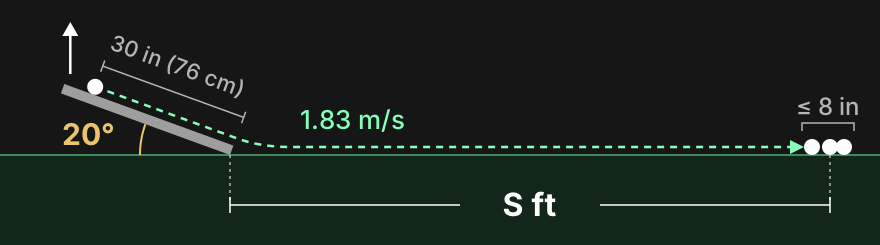
A Stimpmeter is a 36-inch (91 cm) aluminium bar with a groove along it. As the picture shows, taking a reading is very simple:
- Set a ball in the notch (30 inches, 76 cm, from the lower end)
- Slowly raise the bar. At about 20° the ball drops out and rolls down the groove
- The ball always comes out onto the green at the same speed (about 1.8 m/s)
- The distance it rolls before stopping, in feet, is the Stimp reading
Because the ball is always sent off at the same speed, any difference in how far it rolls is a difference in the turf. The less resistance the turf has (the faster the green), the further the ball rolls.
Under the USGA procedure, you roll three balls one way and three back the other way on a flat spot, and average all six. If the three balls in one direction are not within 8 inches (20 cm) of each other, you measure again.
The device grew out of a wooden tool Edward Stimpson built in 1935. In 1976 the USGA redesigned it in aluminium, and from 1978 it came into use at courses everywhere.
What the numbers mean
The USGA gives these guidelines for everyday courses and for the U.S. Open.
| Slow | Medium | Fast | |
|---|---|---|---|
| Everyday courses | 8 ft | 10 ft | 12 ft |
| U.S. Open | 10 ft | 12 ft | 14 ft |
The calculators on this site start at a slightly slow 9.5 ft. If your course posts the day's Stimp reading (often in the pro shop), enter that value.
What to think about on slow and fast greens
When the Stimp reading changes, so does what you need to think about on a putt. Here is the summary first.
| Slow greens (8–9 ft) | Fast greens (11 ft and up) | |
|---|---|---|
| Pace | You have to hit it firmly to get there. Watch out for leaving it short | Stroke it gently, but the change in pace is smaller than it feels |
| Break | Less break. Play a shallower line | More break. Read more break than usual |
| Uphill and downhill | Relatively little difference between them | Downhill putts run a very long way. Avoid leaving yourself downhill putts |
| Where to aim | Pace that gets it well past the hole, on a slightly shallower line | Read more break, and don't hit downhill putts too hard |
| Avoiding three-putts | Watch out for leaving long putts short | Leave approaches below the hole so you don't face a downhill return putt |
Here are the numbers behind that table.
Break is roughly proportional to the Stimp reading
We calculated how far to the side of the hole to aim on a 3 m putt with a 1° side slope (with pace that would finish 40 cm past).
| Stimp reading | 8 ft | 10 ft | 12 ft | 14 ft |
|---|---|---|---|---|
| Aim (3 m, 1° side slope) | 22 cm | 27 cm | 32 cm | 38 cm |
| Aim (5 m, 2° side slope) | 82 cm | 105 cm | 129 cm | 155 cm |
Each extra foot on the Stimp adds about 2.7 cm to the aim on the 3 m, 1° putt. A line that is one cup out at 10 feet becomes about 1.3 cups at 13. On a fast green the ball rolls for longer, so the slope has longer to push it sideways.
Pace changes less than you think
The pace (start speed) needed to roll a given distance changes much less than the Stimp reading does.
| Stimp reading | 8 ft | 10 ft | 12 ft | 14 ft |
|---|---|---|---|---|
| Start speed to stop 3 m away | 2.28 m/s | 2.07 m/s | 1.91 m/s | 1.79 m/s |
| Time to roll 3 m | 3.0 s | 3.4 s | 3.7 s | 4.0 s |
Going from 10 to 12 feet changes the required start speed by less than 10%. The break goes up by 20%, but the pace only comes down by a little under 10%. Fast greens feel scary to putt on because this small adjustment is hard to feel.
The flip side is that misjudging the speed shows straight up in your pace. A 5 m putt struck for a 10 ft green finishes 22 cm short if the green is really 9.5, and 22 cm long if it is 10.5.
The faster the green, the more slopes a ball cannot stop on
If the slope pushes the ball harder than the turf holds it back, the ball keeps rolling. Fast greens have less resistance, so the ball cannot stop even on gentler slopes.
| Stimp reading | 8 ft | 10 ft | 12 ft | 14 ft |
|---|---|---|---|---|
| Steepest slope a ball can stop on | 5.6° | 4.5° | 3.7° | 3.2° |
That is why downhill putts on fast greens are so scary: close to this limit, the ball is very reluctant to stop. Measurements on real turf show balls failing to stop on slightly gentler slopes than this (about 3.3° at Stimp 10). It is also why there are so few places to cut a hole at tournaments.
A warning when measuring on a slope
If there is no flat spot, does averaging the two directions remove the slope? In fact, an ordinary average always reads too fast. The correct formula is:
Stimp reading = 2 × uphill × downhill ÷ (uphill + downhill)
This is the correction published by Brede (1990) for the USGA. Here is a Stimp 10 green on a slope.
| Slope | Uphill roll | Downhill roll | Ordinary average | Correction formula |
|---|---|---|---|---|
| 1.3% | 8.4 ft | 12.3 ft | 10.4 ft | 10.0 ft |
| 2.1% | 7.7 ft | 14.4 ft | 11.0 ft | 10.0 ft |
| 4.4% | 6.1 ft | 27.6 ft | 16.8 ft | 10.0 ft |
The steeper the slope, the further off the ordinary average gets: at 4.4% a 10 ft green reads 17. With the correction formula, every slope comes back to 10.0.
Summary
- The Stimp reading is how many feet a ball sent off at a fixed speed rolls on a flat green
- Everyday courses run at about 8–12 ft; tournaments at 12–14 ft
- Break is roughly proportional to the Stimp reading: going from 10 to 13 gives 1.3 times the break
- Pace changes little: going from 10 to 12 changes it by less than 10%
- The faster the green, the more slopes a ball cannot stop on, and the harder downhill putts become
- When measuring on a slope, use the correction 2 × uphill × downhill ÷ (uphill + downhill)
To see how the break changes at your own course's speed, move the green speed in the Putt Break Calculator and watch it in 3D. For a table of aim points by distance and slope, use the Break Chart.
Appendix: the calculations
This section explains, with equations, where the numbers in the article come from.
The speed the ball leaves the Stimpmeter
From the notch to the lower end is 30 inches (0.762 m) at 20°, so the ball drops h = 0.762 × sin 20° ≒ 0.261 m. For a rolling ball, part of the potential energy goes into spin. With the moment of inertia of a sphere I = (2/5) m r²,
m g h = ½ m v² + ½ I ω²,  ω = v / r
  ⇒  v = √( (10/7) g h ) ≒ 1.91 m/s
The Stimpmeter groove is a V with a 145° included angle, so the ball rolls on its two faces. The radius it turns about shrinks to r_eff = r cos 17.5° ≒ 0.954 r, so at the same speed it has to spin faster.
ω = v / r_eff
  ⇒  v = √( 2 g h / (1 + (2/5)(r / r_eff)²) ) ≒ 1.88 m/s
The nominal 1.83 m/s (6.0 ft/s) is about 3% lower, which can be put down to losses such as resistance in the groove. Since the bar is tilted at 20°, the component carrying the ball along the green is v_s = 1.83 × cos 20° ≒ 1.72 m/s. This agrees well with the value worked back from Brede's (1990) measurements (1.70 ± 0.03 m/s).
Stimp reading and rolling resistance
Writing the turf's deceleration as μg (μ being the rolling-resistance coefficient), a ball that starts rolling at v_s stops after
S = v_s² / (2 μ g) ⇔ μ = v_s² / (2 g S)
The Stimp reading is inversely proportional to μ; at Stimp 10, μ ≒ 0.050 (a deceleration of 0.49 m/s²).
| Stimp reading | 8 ft | 10 ft | 12 ft | 14 ft |
|---|---|---|---|---|
| Rolling resistance μ | 0.0618 | 0.0495 | 0.0412 | 0.0353 |
The start speed to roll a distance D is v₀ = √(2μgD) = v_s √(D/S), so it only scales with √S. The start speeds in the article's table are about 20% higher than this formula because they include the speed lost to the hop and skid right after impact (see "The first 20% of a putt is not rolling at all").
Why break is proportional to the Stimp reading
On a side slope θ, a rolling ball is pushed sideways at a = (5/7) g sin θ (the 5/7 is because part of the force goes into speeding up the spin). Along its path, it slows at μg. Divide the equations of motion by μg and the shape of the path depends only on this ratio:
(5/7) sin θ / μ ∝ sin θ × S
The same "slope × Stimp" gives practically the same line. While the break is modest it is proportional to this ratio, so break is roughly proportional to the Stimp reading.
The steepest slope a ball can stop on
A ball can stay still as long as the slope's push does not exceed the turf's resistance:
(5/7) g sin θ ≤ μ g ⇒ tan θ ≲ (7/5) μ
The article's table includes the slight rise in turf resistance just before the ball stops (up to 15% in this site's model).
The correction formula on a slope
On a slope φ, the deceleration going up and down is μg ± (5/7) g sin φ.
S↑ = v_s² / (2 (μg + k)),   S↓ = v_s² / (2 (μg − k))     (k = (5/7) g sin φ)

1/S↑ + 1/S↓ = 4 μ g / v_s² = 2 / S
  ⇒  S = 2 S↑ S↓ / (S↑ + S↓)
Adding the reciprocals cancels the slope term k, so the harmonic mean of the two directions is the correct Stimp reading.
Conditions: this site's physics model (rolling resistance calibrated from the Stimp reading; hop, skid and pure rolling; capture judged at the rim of the hole). Start speeds, times, aim points and holdable slopes include the low-speed rise in resistance (15%). Stimpmeter dimensions and the guideline values are from the USGA.
- A. D. Brede, "Measuring Green Speed on Sloped Putting Greens", USGA Green Section Record 28(6), 1990
- J. Lemons, "Putting Green Speeds, Slopes, and 'Non-Conforming' Hole Locations", USGA Green Section Record 46(4), 2008
- B. W. Holmes, "Dialogue concerning the Stimpmeter", The Physics Teacher 24, 1986