How much does the golf ball really matter? Tour (spin) balls vs distance balls, tested with physics and robot data
- Full-swing yardage
Walk into any golf shop and you will see a wall of nearly identical white balls labelled "tour", "spin", "distance" and "soft". A dozen of the cheapest and a dozen of the most expensive can differ in price by a factor of three. So how much does that difference actually show up in your score?
In this article we use only what physics can explain and what robots have measured, not manufacturers' marketing, to compare tour (spin) balls with distance balls: driver, irons, short game and putting, in that order. The calculations use the same ball-flight model as this site's Range Finder and the same putting model as the Putt Stroke Simulator. The formulas are collected at the end; the main text focuses on results and the reasons behind them.
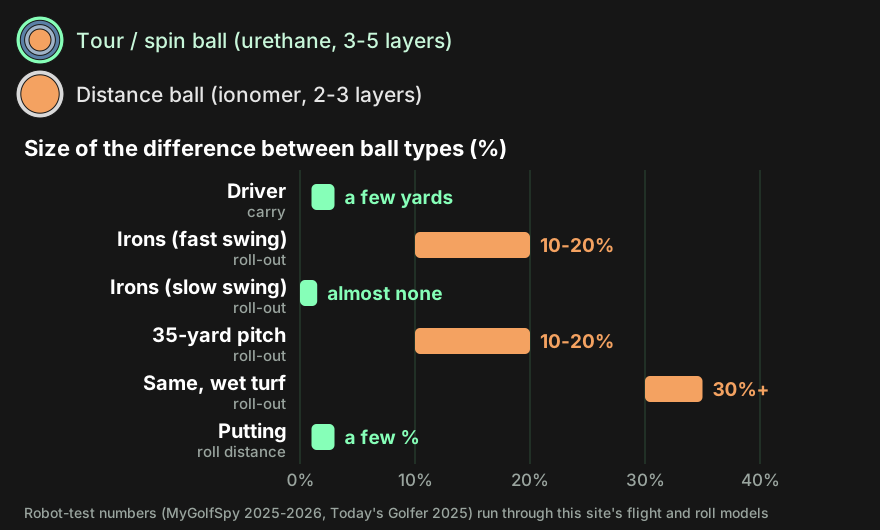
The short answer
| Situation | Difference between balls | Why |
|---|---|---|
| Driver | A few yards of carry. A distance ball is not necessarily longer | The rules cap initial velocity, and every ball is built close to the limit. The difference comes mainly from softer balls leaving the face slightly slower |
| Driver curvature | 300 rpm more spin makes a slice curve about 10% more | The sideways force is roughly proportional to spin. But your swing matters far more than the ball |
| Irons (fast swingers) | A tour ball spins 400-1,000 rpm more, carries 2-5 yards shorter and rolls 10-20% less after landing | The hardness design of the inner layers changes full-swing spin |
| Irons (slow swingers) | Almost no difference (under 100 rpm of spin) | The ball isn't compressed enough for the inner-layer design to show |
| 30-40 yard pitches | A tour ball spins 600-1,250 rpm more and rolls 10-20% less after landing | The soft urethane cover grips the grooves and face texture |
| Pitches from wet turf | The gap widens: more than 30% less roll | A distance ball loses about a third of its spin when wet; a tour ball loses only about a tenth |
| Putting | A few percent of distance for the same stroke (10-20 cm on a 6 m putt) | Only small differences in rebound and surface slipperiness. Much smaller than your stroke-to-stroke spread (10-20%), and it disappears once you get used to the ball |
| So which should you use? | If you want the ball to stop around the green, a tour ball. For everyone else the difference is small. Either way, sticking to one model helps the most | Switching balls every round throws off your distance control on pitches and putts |
What is the difference between tour balls and distance balls?
First, some definitions.
- Tour (spin) ball: a soft urethane cover with 3-5 layers inside. Pro V1, TOUR B, Z-STAR and Chrome Tour are examples
- Distance ball: a firmer ionomer cover (often called Surlyn), usually 2-3 layers, and cheaper
"Soft" balls usually refer to balls whose core is soft to give a lighter feel at impact, whichever cover they have. That is a separate axis from the cover material: there are soft distance balls and firm tour balls.
What the rules fix
Ball performance is capped by the Rules of Golf (USGA and R&A equipment rules).
- Weight no more than 45.93 g, diameter at least 42.67 mm
- Initial velocity and total distance are capped when hit under fixed test conditions
In other words, every manufacturer builds balls that go as far as the rules allow, so differences in ball speed are small to begin with. This distance test is also getting stricter: the test swing speed rises from 120 mph to 125 mph. It applies to elite competition from 2028 and to everyday golfers from 2030; a male amateur with a mid-90s mph swing speed is expected to lose 5 yards or less off the tee (GOLF.com, December 2023).
Why does spin change?
Spin is created in the instant of impact, when friction between the face and the ball "rubs" the ball's surface. The key question is whether the ball grips the face during contact.
- When it grips: on a full shot with a less-lofted club, the ball is squashed hard against the face, the sliding stops partway through, and the ball leaves "rolling" up the face. Spin is then set almost entirely by loft and clubhead speed, and the cover's friction no longer matters (friction only does work until the sliding stops)
- When it keeps sliding: on a slow, high-lofted wedge shot around the green, the ball is pressed only lightly and leaves while still sliding up the face. Now more friction means more spin. The soft urethane cover sinks into the grooves and the fine texture of the face, so friction is higher
That is why the cover makes the clearest difference on short pitches. On full shots, spin depends more on the combination of hardness of the inner layers than on the cover. The more the ball is compressed, the more the inner-layer design matters, so the spin gap between balls grows with swing speed.
Robot tests agree with this. In MyGolfSpy's 2026 ball test (48 models, measured with Trackman):
- The 7-iron spin spread was about 1,300 rpm at 90 mph swing speed, but at 65 mph the average difference between urethane and ionomer was under 100 rpm
- On a 35-yard wedge, urethane averaged about 1,250 rpm more than ionomer
In the same test, though, one urethane ball spun only 4,274 rpm on the 35-yard shot while another spun 5,948 rpm (MyGolfSpy). A urethane cover does not guarantee that the ball will stop.
Driver: a few yards
Driver distance is set mainly by three things: ball speed, launch angle and spin. Changing the ball changes ball speed and spin a little. We used the flight model (tuned to tour-average ball flights) to see how much each one matters.
Swing speed 102 mph (ball speed 148 mph, launch 13°, 2,600 rpm, carry about 244 yards):
| Change | Change in carry | Landing angle |
|---|---|---|
| Ball speed +1 mph | +2.0 yards | about the same |
| Ball speed −3.5 mph (softer ball) | −7 yards | about the same |
| Spin +300 rpm | +1.2 yards | 2° steeper (less roll after landing) |
At 116 mph swing speed (ball speed 169 mph), +300 rpm adds 2.1 yards of carry; at 86 mph (ball speed 123 mph) it adds 1.1 yards. More spin makes the ball climb a bit higher and carry slightly farther, but it lands more steeply and rolls less, so total distance hardly changes, or drops slightly.
How big are the real differences between balls? In MyGolfSpy's 2026 test (116 mph swing speed), ball speed across all 48 models differed by less than 6 mph and spin by about 600 rpm. The 10 softest balls averaged 3.5 mph less ball speed than the 10 firmest, which in the table above means about 7 yards of carry. Meanwhile, urethane balls averaged about 4 yards more total distance than the field, and the ionomer "Vice Tour" was longer than 26 of the 38 urethane models. "Distance balls go farther" and "tour balls go shorter" are both oversimplifications.
For slower swingers the gap is even smaller. In MyGolfSpy's breakdown of its 2025 test, total driver distance in the slow-speed group clustered between 218 and 223 yards regardless of cover type (MyGolfSpy).
Curvature changes by about 10%
A slice or hook curves because the spin axis is tilted, so part of the lift acts sideways. The sideways force is roughly proportional to spin, so with the same swing, a higher-spinning ball curves a little more.
For a slice with the spin axis tilted 10° at 102 mph swing speed:
- 2,600 rpm ball: 17.5 m right
- 2,900 rpm ball: 19.3 m right
The curve grows by about 10%. But tilting the spin axis from 10° to 20° roughly doubles the curve. The size of your curve comes almost entirely from your swing (face angle and path); the ball accounts for about a tenth of it.
Irons: a difference only for faster swingers
With irons, spin decides whether the ball holds the green. We ran a 7-iron at 80 mph swing speed (a typical male amateur; ball speed 110 mph, launch 19°).
| 7-iron spin | Carry | Landing angle | Roll after landing (rough) |
|---|---|---|---|
| 5,400 rpm (typical distance ball) | 161 yards | 46.3° | baseline |
| 6,600 rpm (typical tour ball) | 156 yards | 47.1° | about 20% less |
These spin values come from MyGolfSpy's 2025 test, where most non-urethane balls in the roughly 80 mph group spun 5,400-5,900 rpm and the highest-spinning urethane balls spun 6,600-6,700 rpm. The higher-spinning ball flies a little higher and carries about 5 yards shorter. The size of the gap depends on the test, though. In Today's Golfer's 2025 robot test (7-iron at 80 mph, 62 models), two-piece balls averaged 4,281 rpm and four-piece tour balls 4,699 rpm, a gap of only about 400 rpm. In that case the roll difference is about 5%.
What matters for club selection is the carry difference, so if you change balls, start by re-measuring your 7-iron carry.
"Roll after landing" is estimated from the forward speed at the moment the landed ball grips the turf (see the notes at the end). The backspin still left when the ball lands brakes its forward motion. 1,000 rpm of backspin takes about 0.6 m/s off the forward speed at that moment, and since roll distance goes with the square of speed, that comes to about a 20% difference.
For slower swingers (around 65 mph), as noted above, the spin difference is under 100 rpm. Carry then differs by 0.3 yards and roll barely at all, so with irons you will hardly notice a change of ball. If you want to hold greens, launching higher and dropping the ball in steeply (using more loft) helps far more than the ball.
Short game: where the ball matters most
The 30-40 yard pitch is where ball differences show most clearly. In MyGolfSpy's 2026 test (56° wedge, 35 yards), median spin was 5,390 rpm, urethane averaged 1,250 rpm more than ionomer, and the lowest-spinning ball spun about half as much as the highest.
Putting this into the flight model:
| 35-yard pitch | Spin | Roll after landing (rough) |
|---|---|---|
| Distance ball (dry turf) | about 4,100 rpm | baseline |
| Tour ball (dry turf) | about 5,400 rpm | about 20% less |
| Distance ball (wet turf) | about 2,800 rpm | about 30% more |
| Tour ball (wet turf) | about 4,900 rpm | about 10% less |
Today's Golfer's 2025 test (40 yards) also found two-piece balls averaging 5,449 rpm and five-piece tour balls 6,071 rpm. The gap varies between tests, from 600 to 1,250 rpm, but the direction is the same: tour balls roll 10-20% less.
On wet turf, water gets between the face and the ball and cuts friction, so spin drops. In MyGolfSpy's test (100-yard wedge), ionomer balls lost nearly a third of their spin when wet, while urethane lost only about a tenth. A soft cover that sinks into the face keeps its friction better even with water present. The wet values in the table simply apply these losses to the 35-yard shot, as a rough guide.
Carry (the distance in the air) was almost the same for every ball. What the ball changes on a pitch is the distance from landing to stopping. If you judge distance by a carry-to-roll ratio ("1 part carry, 2 parts roll" and so on), changing the ball will shift that ratio.
Putting: a real difference, but smaller than your own spread
There are four ways the ball could affect a putt. We sized each one with the putting model (Stimp 10, blade putter).
1. Rebound (how the ball springs off the face)
With the same stroke, a livelier ball leaves faster and rolls farther. We could not find published data on putter-ball restitution for individual balls, so we calculated what happens if the coefficient of restitution differs by 0.03 (this site's default is 0.85).
| Distance | Restitution 0.82 | 0.85 | 0.88 |
|---|---|---|---|
| 3 m | 2.90 m | 3.00 m | 3.10 m |
| 6 m | 5.80 m | 6.00 m | 6.22 m |
| 10 m | 9.68 m | 10.00 m | 10.33 m |
A restitution difference of 0.03 changes distance by about 3%, about 20 cm on a 6 m putt.
2. Surface slipperiness
Right after impact the ball doesn't have enough spin yet, so it slides a little on the grass before it starts rolling (see the skid article). The lower the friction while it slides, the longer it slides, and the farther it goes overall. If the friction coefficient with the grass changes by ±0.05 from 0.25, a 6 m putt changes by +3% / −2%. However, this friction depends largely on the grass, and we found no data on how much the cover material changes it.
3. Weight
The rules allow at most 45.93 g. Even if two balls differed by 0.6 g, ball speed would change by only about 0.2%, or about 2 cm on a 6 m putt. Not worth worrying about.
4. Off-centre mass
If the centre of mass is offset from the ball's centre, the ball drifts a little as it rolls. Calculations by Daemi et al. (Sports Engineering, 2015) found that an offset of only about 0.2% of the radius can make a 5.8 m putt on a flat green miss the hole. This is about manufacturing variation from ball to ball rather than the type of ball (tour or distance). There are gadgets for checking balance and a method of floating balls in strong salt water, but we found no independent data on how much offset commercial balls actually have.
Feel and sound
Some golfers feel that a soft tour ball is "heavier" or "comes off slower" on putts. In an experiment by Barrass et al. (Journal of Sports Sciences, 2006), the ball golfers rated "hardest" and "fastest off the face" was also the one with the loudest, highest-pitched sound. Much of what we call feel is judged by sound, so the difference you feel tends to be larger than the actual difference in ball speed.
Putting in summary
If you stick with one ball, a few percent is something your body adjusts to within a few putts on the practice green. As shown in How to make your putting distance more consistent, an amateur's stroke-to-stroke distance spread is 10-20%, several times larger than the ball effect. On the greens, the problem is not which ball you use but switching balls from round to round or hole to hole.
Do slow swingers need a soft ball?
You often hear that "a ball with compression matched to your swing speed goes farther". Robot tests do not support this.
- In MyGolfSpy's 2026 test, softer balls were slower and generally lower-spinning off the driver
- But with a 7-iron at 65 mph, the three softest balls were the three fastest
- In the 2025 test, the longest driver ball at 85 mph swing speed was a firmer tour ball (MyGolfSpy)
Physically, a soft ball stays compressed longer and tends to lose more energy inside, but with a slow swing the ball is compressed so little that differences are hard to see. The robot tests' answer is that compression alone does not decide distance; differences between models are larger. The main reason to choose a soft ball is simply whether you like how it feels.
Is the more expensive tour ball worth it? (a neutral view)
This section assumes that tour balls cost more. For most brands a tour ball costs more per ball than the same maker's distance ball, sometimes nearly twice as much.
With that in mind, there is a single test: do you have shots in your game that use what only a tour ball does better, namely stopping the ball on pitches and iron shots? If you play many of those shots, the extra money buys a real effect. If not, you pay more and your results barely change.
| If you... | Value of a tour ball | Why |
|---|---|---|
| want to fly 30-50 yard pitches in high and stop them | High | This is where ball differences are largest: 10-20% less roll, and over 30% less on wet days |
| swing fast (85 mph+ with a 7-iron) and attack greens from above | Some | Iron shots also roll 10-20% less after landing |
| swing slowly and mostly bump-and-run around the green | Low | The iron spin gap is under 100 rpm, and a running chip doesn't need to stop. There are almost no shots where the advantage is used |
| lose several balls a round | Low | The advantage is real, but you keep buying expensive balls to replace lost ones. If you run out and switch to another model, your distance control won't match either. A cheaper ball you can always stock is better |
| struggle with a slice and want it to curve less | Not relevant (switching to a distance ball reduces the curve by only about 10%) | The size of the curve is set almost entirely by your swing. Choosing a ball won't fix it |
Apart from price, keep in mind that a tour ball's soft cover scuffs easily. Scuffs or a peeling cover change the airflow and make the flight less predictable.
Summary for players
- Once you choose a ball, keep using the same model. Distance control on pitches and putts shifts every time the ball changes
- If you want pitches to stop, use a tour ball (urethane cover). But some urethane balls spin little, so choose by test numbers
- Slower swingers can choose by price and feel. Driver and iron differences are tiny
- On rainy days, pitches roll more. Especially with a distance ball, carry it shorter and allow for more roll
- When you change balls, re-measure your 7-iron carry and how far a 30-yard pitch rolls
- A few percent on putts is fixed by a few balls on the practice green. Much of the difference in feel comes from sound
Notes: calculation details
Ball-flight model
Three forces act on the ball: gravity, drag and lift (the Magnus effect).
Drag = ½ ρ A C_D v²      Lift = ½ ρ A C_L v²
C_D = 0.20 + 0.40 × min(S, 0.5)
C_L = 0.64 × S / (0.25 + S)       S = ω r / v (spin ratio)
ρ is air density (1.2 kg/m³), A the ball's cross-section, ω the spin (rad/s) and r the ball radius. Spin decays during flight with a time constant of 22 s. The functional form is the same as this site's Range Finder; the coefficients were tuned to Trackman's published PGA Tour averages (driver: 171 mph ball speed, 10.4° launch, 2,545 rpm, 282 yards carry; 7-iron: 123 mph, 7,124 rpm, 176 yards) (Golf Monthly). The model reproduces 282 yards for the driver, 176 yards for the 7-iron and 139 yards for the pitching wedge (published: 142 yards).
Slices were calculated by tilting the spin axis about the direction of travel so that part of the lift acts sideways.
Rough roll after landing
If a rigid ball stops sliding while in contact with the turf and switches to rolling, its forward speed afterwards is
v' = (5/7)·v_x − (2/7)·ω r
(v_x is the horizontal speed at landing and ω the backspin at landing). 1,000 rpm more backspin makes v' smaller by (2/7) × 104.7 × 0.0213 ≈ 0.64 m/s. Roll distance is proportional to the square of speed, so the "about 20% less roll" in the text is the ratio of v' squared.
On real turf the ball sinks in and bounces several times before rolling. This rigid-ball model is known to describe speed and spin just after landing only to within about 20% (Sports Engineering, 2023). Treat the roll differences in the text as a rough guide to direction and size.
Putt launch speed
With putter head mass M, ball mass m and coefficient of restitution e, the ball speed from a centred strike is
v_ball = v_head × (1 + e) / (1 + m/M)
Raising e from 0.85 to 0.88 increases ball speed by 1.6%, and since roll distance goes roughly with the square of speed, distance increases by about 3%. Making m 0.6 g lighter only changes m/M from 0.133 to 0.131, so ball speed changes by just 0.2%.
What this model leaves out
- Differences in drag and lift from dimple patterns (no per-model data, so all balls use the same coefficients)
- Differences after landing due to grass type, mowing height and firmness
- Scuffed balls, and changes in ball hardness with temperature
Conditions: air density 1.2 kg/m³, no wind. Driver launch conditions are the robot settings in MyGolfSpy's 2026 test (116 mph: 10.5°, 2,500 rpm; 102 mph: 13°, 2,600 rpm; 86 mph: 13°, 3,000 rpm). Ball speed is 168.7 mph at 116 mph (the test median), and 148 mph and 123 mph at 102 mph and 86 mph. The 35-yard pitch uses 19 m/s ball speed and 32.2° launch (the test medians). Putts use Stimp 10, a flat green and a blade putter (345 g), with the same model as the Putt Stroke Simulator.
Sources: MyGolfSpy (2026 ball test, 48 models), MyGolfSpy (2025 test by cover type), MyGolfSpy (a urethane cover doesn't guarantee high spin), MyGolfSpy (distance by swing speed, 2025 test), Today's Golfer (2025 robot test, 62 models), GOLF.com (ball rule change, December 2023), R&A (ball construction and distance research), Golf Monthly (Trackman PGA Tour averages), Daemi et al. (off-centre mass and putting, Sports Engineering, 2015), Barrass et al. (impact sound in putting, Journal of Sports Sciences, 2006), Sports Engineering (measuring and modelling ball bounce on a green, 2023).