Is AimPoint physically correct? Testing the finger method with a ball-roll model
- Greens & ball roll
It has become a familiar sight on tour broadcasts. A player straddles the line and feels the ground for a moment, then stands behind the ball, closes one eye, and holds up one or two fingers against the hole. This is the green-reading method called AimPoint.
"Feel the slope with your feet, one finger per 1% of slope" can sound like a superstition. And some tour players do criticise it, saying it "statistically hasn't helped anybody".
In this article we first summarise the basic method as it is presented on various sites. Then we check whether aiming with fingers is physically correct, using the same ball-roll model as the Putt Break Calculator. We also cover how to make it more precise, how to correct for body differences such as finger width and arm length, and the criticisms of AimPoint, without taking sides. The formulas are collected in the notes at the end. The main text gives only the conclusions and the reasons.
The short answer
| Question | Answer |
|---|---|
| Is aiming with fingers physically correct? | The idea is sound. As long as you putt at a pace that finishes just past the hole, the aim angle needed hardly depends on putt length and is nearly proportional to the slope. That is why "angle = finger width" works |
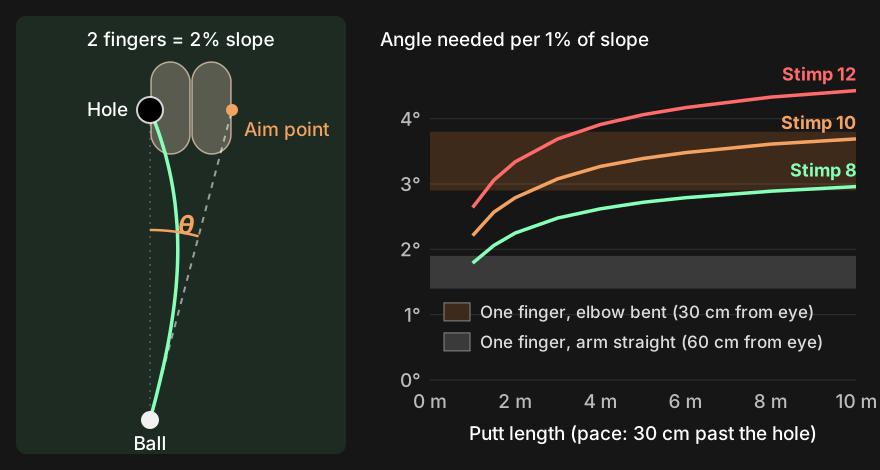
| What angle should one finger cover? | Per 1% of side slope, about Stimp × 0.33° (4 m putt, pace 30 cm past). About 3.3° at Stimp 10 |
| Is one finger at arm's length enough? | No. One finger at arm's length covers about 1.5 to 1.9°, which only suits a very slow green of around Stimp 5. You need to bend the elbow and bring the fingers closer to your eye |
| Do body differences matter? | Yes. A finger 20% wider moves the aim point by 20%. The most reliable fix is to set a marker beside a hole and calibrate your own finger once |
| How big is the error with distance? | If you calibrate the finger angle on a 4 m putt, putts of 2 m or less get 3 to 4 cm too much break and putts of 8 m or more get 10 cm or more too little (2% side slope) |
| Where should you read the slope? | The aim is set almost equally by the slope over the first three quarters of the putt. The slope right by the hole, where the break becomes visible, actually counts least |
| How costly is a misread? | On a 3 m putt with 2% slope, misreading by 0.5% drops the make rate from 64% to about 25% (with a stroke as consistent as a good player's) |
| So should you use it? | For players who tend to under-read break by eye, the big advantage is that it turns the read into a number you can correct with practice. But we found no independent study showing that people can feel 0.5% with their feet, and the statistics on whether it works are disputed |
What AimPoint is
AimPoint is a green-reading method devised by Mark Sweeney in the United States. It started as a theory for calculating break from slope and green speed, and Sweeney also built the virtual putting line used on broadcasts by Golf Channel and others (Golfweek, April 2024).
Originally you looked up the aim in a chart from slope, distance and speed. Today the most common form is a simplified version, AimPoint Express, which replaces the chart with a number of fingers. According to Sweeney, it began when he was teaching 7- and 8-year-olds and noticed by chance that "one finger per 1% of slope" came out about right.
Many tour players use it, including Max Homa, Viktor Hovland, Collin Morikawa, Adam Scott and Tommy Fleetwood. Others, such as Tiger Woods and Jordan Spieth, do not (same article).
The basic method (what the sources agree on)
Details vary between sources, but the steps are roughly as follows (Golfweek, GOLF.com, Bowtied Gopher and others).
- Feel the slope with your feet. Stand about halfway between ball and hole, straddling the line and facing the hole. The foot that takes more weight is on the low side. Put a number on the slope: 1%, 2%, 3% and so on
- Check the slope more than once. Some versions also feel it at one third and two thirds of the way and use the larger value
- Stand behind the ball and hold your arm out. Close your non-dominant eye and hold up as many fingers as the slope number (one for 1%, two for 2%)
- Line the fingers up with the hole. Put the low-side edge of your fingers on the centre of the hole; the other edge marks the aim point
- Roll the ball at the aim point at a pace that finishes a little past the hole (about 30 cm)
Most greens have slopes of 1 to 3%; 4 to 5% is rare. AimPoint uses only the slope across the line. Uphill and downhill are handled separately as an adjustment to the aim.
Where the sources disagree
The following points are explained differently from source to source. We will look at which is right from the physics later.
| Point | Different explanations |
|---|---|
| Where the fingers go on the hole | On the centre of the hole / just outside the edge of the hole |
| Arm position | Arm fully straight / the faster the green, the more you bend the elbow and bring the fingers to your eye |
| Where to read the slope | One spot halfway / the larger of the one-third and two-thirds readings / three spots (ball, halfway, hole) with the hole side weighted more |
| Uphill and downhill | Some give a rule of thumb (take away half to one finger uphill, add downhill); others do not mention it |
| Short putts (2 m or less) | Often a separate routine: fingers held from directly over the ball, the edge of the hole as reference, and so on |
In lessons, it seems you are taught to adjust how much you bend your arm by watching your own results. In other words, AimPoint Express is not a fixed rule of "one finger = so many degrees". It is a method that assumes each user calibrates it for themselves.
Checking it with physics
From here we use the site's ball-roll model (the same one as the Putt Break Calculator) to test AimPoint's assumptions one by one. Unless stated otherwise, we use Stimp 10, a uniform side slope only, and a pace that finishes 30 cm past the hole, and calculate the aim needed to send the ball through the centre of the hole. The aim angle is the angle between the line from ball to hole and the start direction.
The angle needed hardly depends on distance
AimPoint's key assumption is that the aim angle is set by the finger width, whatever the putt length. A finger's width is an angle seen from the eye, so one finger covers the same angle whether the hole is near or far. Double the distance and the offset of the aim point doubles automatically.
We checked whether this holds physically for a 1% slope.
| Putt length | Angle needed | Aim offset at the hole |
|---|---|---|
| 1 m | 2.2° | 4 cm |
| 2 m | 2.8° | 10 cm |
| 3 m | 3.1° | 16 cm |
| 4 m | 3.3° | 23 cm |
| 6 m | 3.5° | 37 cm |
| 8 m | 3.6° | 50 cm |
| 10 m | 3.7° | 65 cm |
From 3 m to 10 m the angle barely moves, staying between 3.1 and 3.7°. The foundation of the finger method is physically correct.
The reason lies in how ball speed and break relate. For a putt that just reaches the hole, a longer roll means more time for the slope to push the ball sideways, but the ball also starts faster. The calculation shows that these two effects cancel exactly, so the aim angle depends only on "side slope ÷ rolling resistance", not on distance (see the formula in the notes). When the putt finishes a little past the hole, shorter putts reach the hole faster and break a bit less. That is why the angle is smaller at 1 to 2 m.
The angle needed is nearly proportional to slope
We also checked whether "one finger for 1%, two for 2%" holds (2 m and 4 m).
| Side slope | 2 m | 4 m |
|---|---|---|
| 1% | 2.8° | 3.3° |
| 2% | 5.7° (2.0 × 1%) | 6.6° (2.0 ×) |
| 3% | 8.6° (3.1 ×) | 10.1° (3.1 ×) |
| 4% | 11.8° (4.2 ×) | 13.9° (4.2 ×) |
Up to 2% it is exactly proportional; at 3 to 4% the ball breaks just under 10% more. Making the number of fingers proportional to the slope is physically right. However, the ring and little fingers are often narrower than the index finger, so four fingers are usually less than four index-finger widths. When you use three or four fingers on a steep slope, both effects mean you are likely to under-read the break.
The angle needed is proportional to green speed
What AimPoint explanations rarely stress is green speed. The angle needed per 1% of slope (4 m) is almost proportional to the Stimp reading.
| Stimp | 8 | 9 | 10 | 11 | 12 | 13 |
|---|---|---|---|---|---|---|
| Angle needed | 2.6° | 2.9° | 3.3° | 3.6° | 3.9° | 4.2° |
The rule of thumb is Stimp × 0.33°. On a fast green the rolling resistance is low, so the ball takes longer to drift towards the hole and gets pushed further sideways.
How many degrees is one finger? Not enough at arm's length
So what angle does one finger cover from your eye? With finger width w and distance from eye to finger L, the angle is w ÷ L (in radians).
With an index finger 1.8 cm wide and 60 cm from the eye at arm's length, one finger covers about 1.7°. In the table above, that suits a very slow green of around Stimp 5. On typical course greens (Stimp 8 to 10) it is only about half the angle needed.
In other words, aiming with "1% = one finger" at arm's length makes you read about half the break. Many explanations say "the faster the green, the more you bend your elbow and bring the fingers to your eye", and this is presumably to make up for that gap. Stephen Lee's analysis, an independent calculation of the same thing, found that with a finger 0.75 in (1.9 cm) wide, the finger should be about 11 in (28 cm) from the eye on a flat Stimp 10 green, close to our result (33 cm for the same finger).
That is why you see tour players with their elbows well bent and their fingers close to their face. If you take only "arm straight, one finger = 1%" at face value, you will miss more putts on the low side (the so-called amateur side).
Uphill and downhill act like slower and faster greens
Going uphill the slope acts as a brake, so the ball breaks less, just as on a slower green. Downhill is the opposite: it breaks more, as on a faster green.
Here is the angle needed per 1% of side slope (4 m) for different uphill and downhill slopes.
| Up / down slope | Stimp 8 | Stimp 10 | Stimp 12 |
|---|---|---|---|
| 2% downhill | 3.5° | 4.7° | 6.1° |
| 1% downhill | 3.0° | 3.8° | 4.8° |
| Flat | 2.6° | 3.3° | 3.9° |
| 1% uphill | 2.3° | 2.8° | 3.3° |
| 2% uphill | 2.1° | 2.5° | 2.9° |
At Stimp 10, 1% downhill is almost the same as a flat Stimp 12 green, and 1% uphill is like Stimp 8.5 to 9. In fingers, that is about 1.2 times as many at 1% downhill, 1.4 times at 2% downhill, 0.85 times at 1% uphill and 0.75 times at 2% uphill. The rule of thumb "add half to one finger downhill" is about right for side slopes of 2 to 3%.
Change the pace and the break changes too
AimPoint's angle assumes a pace that finishes about 30 cm past the hole. Hit it firmer and the ball reaches the hole faster, so it breaks less (4 m, 2% side slope).
| Finishes past the hole by | Angle needed | Aim offset |
|---|---|---|
| 15 cm | 7.2° | 51 cm |
| 30 cm | 6.6° | 46 cm |
| 45 cm | 6.1° | 43 cm |
| 60 cm | 5.8° | 40 cm |
| 90 cm | 5.1° | 36 cm |
Between 30 cm and 60 cm past, the aim moves by 6 cm, more than the radius of the hole (5.4 cm). Hitting the same pace every time matters as much as calibrating the finger angle. Put the other way, a player who putts firmly will calibrate with the fingers a little further from the eye.
Without adjusting for distance, short and long putts drift
As the earlier table shows, the angle needed is smaller below 3 m and creeps up on longer putts. We calculated what happens if you calibrate the finger angle on a 4 m putt and keep it for other lengths (2% side slope).
| Putt length | Miss |
|---|---|
| 1 to 2 m | 3 to 4 cm on the high side |
| 3 m | 2 cm high |
| 4 m | 0 (calibrated here) |
| 6 m | 5 cm on the low side |
| 8 m | 10 cm low |
| 10 m | 15 cm low |
From 3 to 6 m the error is smaller than the radius of the hole and does not matter. Physically, the accurate approach is to play slightly less break on short putts and slightly more on long ones. Many explanations use a different routine for putts of 2 m or less (fingers held from over the ball, for example) and step back to read long putts. That may be an empirical way of correcting for this drift.
Note that if you step back a distance b behind the ball to hold up your fingers, the aim offset grows by a factor of (distance + b) ÷ distance. Stepping back 1 m on a 2 m putt makes it 1.5 times larger. The shorter the putt, the bigger the effect of stepping back, so keep that distance the same every time.
Where should you read the slope?
AimPoint sources disagree on where to read: halfway, the larger of the one-third and two-thirds readings, or weighting the hole side more. In our article "Three things to look at first when reading a green" we also explained that most of the break happens just before the hole.
So we split a 4 m putt into four 1 m sections and calculated how much the aim would change if only that section had slope.
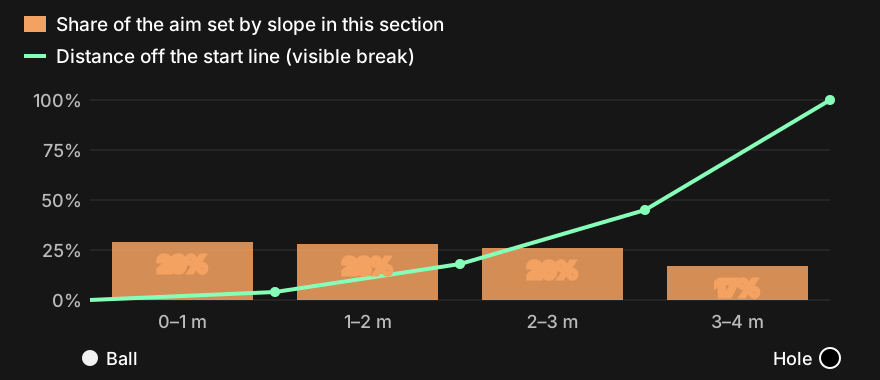
The result was surprising.
- The visible break (how far the ball is off its start line) appears more than half in the last metre before the hole
- But the aim is set almost equally by the slope over the first 3 m (29%, 28%, 26%), and the last metre counts for only 17%
This is because a small change in direction near the ball keeps adding up over the whole remaining distance to the hole. You "see" the curve near the hole because the deviation builds up and shows once the ball slows down, but the slope that caused it is further back. A slope right by the hole changes the ball's direction too, but there is little distance left, so the miss does not grow much.
At 2 m the shares are 31%, 29%, 25% and 14%; at 8 m, 28%, 27%, 26% and 19%. The pattern is the same at every length.
It follows that:
- If the slope is uniform, it does not matter where you read it, so reading halfway is sensible (it represents the whole line)
- If the slope changes along the line, there is no reason to give the ball side less weight. If anything, give the last quarter by the hole a bit less
- Reading "the hole side counts double" points in the opposite direction from the physics
Take a 6 m putt where the first 3 m slope 2% to the left and the last 3 m slope 4% to the right. Weighting the hole side double gives 4 − 1 = 3% of aim to the right, but the ball-roll model says only 0.8 of a finger (0.8%) is needed.
How much does a misread cost?
Finally, we calculated how precisely you need to read the slope. The table shows the make rate for a putt with 2% side slope (Stimp 10) when the slope is misread and the aim matches the misread slope. Stroke dispersion is ±7% in distance and ±0.8° in direction (similar to a good player).
| Slope read | 2 m | 3 m | 5 m |
|---|---|---|---|
| 1.5% (0.5% under) | 50% | 24% | 11% |
| 1.75% | 76% | 50% | 27% |
| 2% (correct) | 86% | 64% | 37% |
| 2.25% | 77% | 51% | 28% |
| 2.5% (0.5% over) | 53% | 27% | 14% |
A 0.25% misread costs 10 to 14 percentage points, and a 0.5% misread more than halves the make rate at 3 m and 5 m. Sweeney says most people can learn to tell half-percent differences in about 15 minutes (Golfweek), but even that is still coarse for holing 3 m putts consistently.
Reading by eye is far from precise either. Putting coach Ralph Bauer says that when we read a putt from above the line, we underestimate the slope by about 25% (Australian Golf Digest). On a 2% slope that is a 0.5% misread. Whether or not you use AimPoint, green reading has a large effect on how many putts you hole.
How to make it more precise
From the physics, here are the points that make AimPoint more precise.
- Check your feet against a level app on your phone. Put an app that shows slope in % on the practice green and compare it with your read. Aim to name the slope to within 0.5%
- Match the angle of one finger to the green speed. Do not keep your arm straight; around Stimp 10, bend your elbow and bring the fingers closer to your eye (see the next section for how)
- Add or take away fingers for uphill and downhill. 1% downhill is like the green being 2 Stimp faster; 1% uphill is like it being 1.5 slower
- Keep the pace constant. Use 30 cm past the hole as the standard, and play less break when you hit it firmer
- Play slightly less break on short putts and slightly more on long ones. About a third of a finger less at 1 to 2 m, and about 10% more at 8 m and beyond
- Read the slope halfway along the line, and if it changes, count the ball side just as much. Give the last quarter by the hole a little less weight
- With three or four fingers you will tend to under-read. Both because the ring and little fingers are narrower, and because break grows faster than proportionally on steep slopes
- Keep track of how you miss. If you often miss low, bring the fingers closer to your eye; if you miss high, move them away
Correcting for body differences
One finger covers "finger width ÷ distance from eye to finger", so the angle differs from person to person with finger width and arm length. Even with the same "slightly bent elbow", a finger 1.6 cm wide and one 2.0 cm wide differ by 25% in angle. On a 4 m putt with 2% slope, that moves the aim point by 9 to 12 cm.
The eye-to-finger distance you need
This is the distance from eye to finger needed for one finger to match 1% of slope (4 m, flat line, pace 30 cm past).
| Index finger width | Stimp 8 | Stimp 10 | Stimp 12 |
|---|---|---|---|
| 1.6 cm | 35 cm | 28 cm | 23 cm |
| 1.8 cm | 39 cm | 32 cm | 26 cm |
| 2.0 cm | 44 cm | 35 cm | 29 cm |
At arm's length (around 60 cm) none of these combinations is reached. You can find your finger width by measuring your index finger around the middle joint with a ruler.
The most reliable way: put a marker beside the hole
Fingers are not straight sticks, though, and their width depends on where you look. So the reliable approach is to calibrate once on a real green with a marker.
- On the practice green, place a ball 4 m from a hole on a nearly flat part of the green
- Put a tee or marker beside the hole, the distance in the table below from the centre of the hole
- From behind the ball, with one eye closed, adjust how much you bend your elbow until one index finger exactly spans "centre of the hole to marker"
- Remember that arm position (where your fist is, the angle of your elbow). Do the same with markers at twice and three times the distance for two and three fingers, and you will also learn how narrow your ring and little fingers are
| Stimp | 8 | 9 | 10 | 11 | 12 | 13 |
|---|---|---|---|---|---|---|
| Marker position (sideways from the centre of a hole 4 m away) | 18 cm | 21 cm | 23 cm | 25 cm | 27 cm | 30 cm |
This corrects for finger width, arm length and the position of your dominant eye all at once. When you play a course with a different green speed, move the marker according to the table and recalibrate. Finally, roll some putts and check that the ball passes through the centre of the hole.
Even if your "felt %" and the real % differ, you can recalibrate
The "1%" you feel with your feet does not actually need to match the real slope. Even someone who always feels a real 2% slope as "1%" will aim correctly if they set the finger angle to twice the size by watching their results. What matters is feeling the same slope as the same number every time. Perhaps some players hole putts with "arm straight, one finger" because this recalibration happens without them noticing. But done that way, the error shows up as soon as the green speed changes.
Criticisms of AimPoint
AimPoint also has persistent critics. Here are the main points.
"Statistically it doesn't work"
Lucas Glover, the 2009 US Open champion, said on his radio show in February 2025 that AimPoint "statistically hasn't helped anybody" and should be banned because it takes too long (GolfMagic, February 2025).
In response, Sweeney said that comparing PGA Tour measurement data (ShotLink) before and after players adopt it shows 90 to 95% of them improving, and demanded a retraction (GolfWRX). Collin Morikawa, one of its users, also pushed back (Golf Channel).
Both claims have problems with how the comparison is made. A before-and-after comparison will look like "improvement" even if players simply try a new method when they are in a slump and then return to their average. Conversely, if users as a group do not putt notably better, it may be that players who already struggled with putting were the ones who took it up. We found no independent study that randomly assigned players to use it or not. At present, neither side's claim is conclusive.
"It slows play down"
The criticism is that stopping at several spots along the line takes time. Sweeney counters that people get slow when they do an AimPoint read and then a traditional read as well, and that used properly it is faster because you no longer need to look at the putt from several angles (Golfweek). This is a question of how it is used, not of physics. Out of consideration for your playing partners, do your reading before it is your turn.
"Nobody can feel a 0.5% slope with their feet"
A 1% slope is 0.57° as an angle. In what we found, no independent study has tested under controlled conditions the claim that the soles of the feet can tell a 0.5% (0.3°) difference. As calculated above, even a 0.5% misread more than halves the make rate, so the precision of your feet is the single biggest factor in whether AimPoint works for you. How you stand (width of stance, which way you face) also changes what you feel, so practising against a level app is essential.
"The physics is too simple"
The finger method assumes a uniform slope. From the calculations, the fingers alone cannot handle the following:
- Green speed: the same single finger needs a 1.5 times larger angle at Stimp 12 than at Stimp 8, so you have to recalibrate the finger angle yourself
- Uphill and downhill: at 2% downhill the ball breaks 1.4 times as much as on the flat
- Pace: on a 4 m putt the aim differs by 6 cm between 30 cm and 60 cm past
- Distance: short and long putts each drift by a few centimetres to well over ten
- Lines where the slope changes along the way, grain, wind and moisture
AimPoint lessons seem to teach ways to compensate for these from experience, but it is worth knowing that "number of fingers = slope" is not the whole story.
A neutral view of how useful AimPoint is
Putting the physics together with the arguments on both sides, we can say the following.
What the physics supports
- The aim angle hardly depends on distance and is nearly proportional to slope. The basis of aiming with "angle = finger width" is sound
- Once you match the angle of one finger to yourself, the distance error on 3 to 6 m putts is smaller than the radius of the hole
What is unsupported or needs care
- We found no independent test of whether people can feel 0.5% with their feet
- "Arm straight, one finger = 1%" reads about half the break on greens of normal speed
- "Weight the slope near the hole more" points in the opposite direction from the physics
- On tour, neither side has conclusive statistics on whether it works
Players AimPoint suits
- Players who, reading by eye, keep under-reading the break and missing low
- Players who want to express their read as a number and improve it through practice
- Players who want to think the same way on greens of different speeds
Players who need not force it
- Players whose aim and misses are already consistent when reading by eye
- Players whose pace varies from putt to putt and who should fix their distance control first (because the right angle changes with pace)
The real value of AimPoint is arguably not the fingers themselves but turning your read into a number so you can correct it from how you miss. A player who reads by eye can get the same benefit by building their own yardstick, such as "with this slope, at 4 m, it's this many cups outside". You can also check the break for any line with the Putt Break Calculator or the Break Chart.
Summary for players
- AimPoint fits the physics: the aim angle hardly depends on distance and is proportional to slope
- The angle needed per 1% of slope is about Stimp × 0.33°, about 3.3° at Stimp 10
- One finger at arm's length (about 1.7°) is not enough. Bend your elbow and bring the fingers closer to your eye
- Finger width and arm length vary. Put a marker beside a hole 4 m away (23 cm out at Stimp 10) and calibrate one finger to it
- 1% downhill is like Stimp +2, 1% uphill like Stimp −1.5. Add fingers downhill, take them away uphill
- Keep hitting a pace that finishes 30 cm past. When the pace changes, the right angle changes
- Play slightly less break at 1 to 2 m and slightly more at 8 m and beyond
- Read the slope halfway along the line. If it changes, weight the first three quarters from the ball at least as much as the part by the hole
- A 0.5% misread more than halves the make rate on a 3 m putt. Practise checking your feet against a level app
- The statistics on whether it works are disputed. It is a useful tool for players it suits; if it does not suit you, it is fine to go back to reading by eye
How hard to hit putts is covered in "Is "17 inches past" really the best pace?", and whether to prioritise pace or line in "Is it better to "hit it firm" or to "play the line"?".
Notes: calculation details
Formula for the aim angle
When the ball rolls without sliding on a green, it decelerates along its path at a = μg from rolling resistance, and is pushed sideways by the slope with acceleration b = (5/7)·g·s (s is the side slope; the 5/7 appears because, for a rolling ball, part of the force goes into speeding up its spin).
Approximating for small start angles, the ball's direction changes by b ÷ (its current speed) per second. Integrating this for a pace that finishes R past the hole gives the angle θ needed to send the ball through the centre of the hole:
θ = (5/14) · s / μ · [ 1 − (R/D) · ln(1 + D/R) ]
where D is the putt length. For a putt that just reaches the hole (R → 0) the bracket becomes 1 and θ = (5/14)·s/μ, independent of distance. The rolling resistance μ follows from the Stimp reading S as μ = v₀²/(2gS) (v₀ ≈ 1.72 m/s is the speed at which the ball leaves the Stimpmeter onto the green), so
θ (just reaching the hole) = (5/7) · g · S · s / v₀²
For 1% slope at Stimp 10 (S = 3.05 m): 0.072 rad ≈ 4.1°
With R = 30 cm and D = 4 m the bracket is 0.80, giving θ ≈ 3.3°. This almost matches 3.27°, the value solved with the site's simulator (which includes the extra resistance at low speed and the skid). Because θ is proportional to the Stimp reading S, the rule of thumb is "Stimp × 0.33°".
Uphill and downhill
With an up/down slope u (uphill positive), the deceleration along the path becomes a = g·(μ + (5/7)·u), and
θ ≈ (5/14) · s / (μ + (5/7)·u) · [ 1 − (R/D) · ln(1 + D/R) ]
At Stimp 10, μ ≈ 0.049, so the denominator is 0.042 at 1% downhill (equivalent to Stimp 11.7) and 0.056 at 1% uphill (equivalent to Stimp 8.7).
How slope in each section counts
With the same approximation, the effect of side slope in a short section dx at distance x from the ball on the sideways miss at the hole is proportional to
(D − x) / (D + R − x)
(a change of direction at that point keeps acting over the remaining distance D − x, while the square of the ball's speed there is proportional to D + R − x). With R → 0 every point counts the same. With R > 0, only the stretch of about R next to the hole counts less. The 29%, 28%, 26% and 17% in the text come from a numerical calculation that includes the extra resistance at low speed.
Finger angle
With finger width w and eye-to-finger distance L, one finger covers w/L radians. With w = 1.8 cm and L = 60 cm that is 0.030 rad ≈ 1.7°. To match a required angle θ, L = w / tan θ. If you step back b behind the ball to hold up your fingers, the angle seen from the ball becomes θ_finger × (D + b)/D.
Make rate
Using the same method as the site's calculator, we integrated over the range of strokes that hole out, with dispersion in pace (log-normal, 7%) and direction (normal, 0.8°). Starting from the best pace and aim for a correct read, we shifted the aim by the difference between the aim for the correct slope and the aim for the misread slope.
What this model does not cover
- Greens whose slope varies from place to place (the section-by-section calculation is a simplified one in which only the side slope varies by section)
- Grain, wind and moisture
- The precision of the feet itself (it varies by person and we found no study that measured it)
Conditions: unless stated otherwise, Stimp 10, a uniform side slope only, a pace that finishes 30 cm past the hole, no grain or wind. The ball-roll model is the same as the Putt Break Calculator (including the hop, the skid and the extra resistance at low speed). The finger widths of 1.6 to 2.0 cm and the 60 cm from eye to finger at arm's length are examples for explanation, not measurements.
Sources: Golfweek (interview with Mark Sweeney, April 2024), GOLF.com (how AimPoint works), Bowtied Gopher (intro to AimPoint), Stephen Lee (Calibrating AimPoint Express, November 2025), GolfMagic (Lucas Glover's comments, February 2025), GolfWRX (Mark Sweeney's response), Golf Channel (Collin Morikawa's response), Australian Golf Digest (Ralph Bauer on reading greens).